The most common question about the Novelty Threshold is not about what it is. It is about why no one sees it coming.
The answer is not that practitioners are careless. It is not that institutions are negligent. It is not that assessment systems are poorly designed, that AI risks are underestimated, or that oversight functions are insufficiently rigorous.
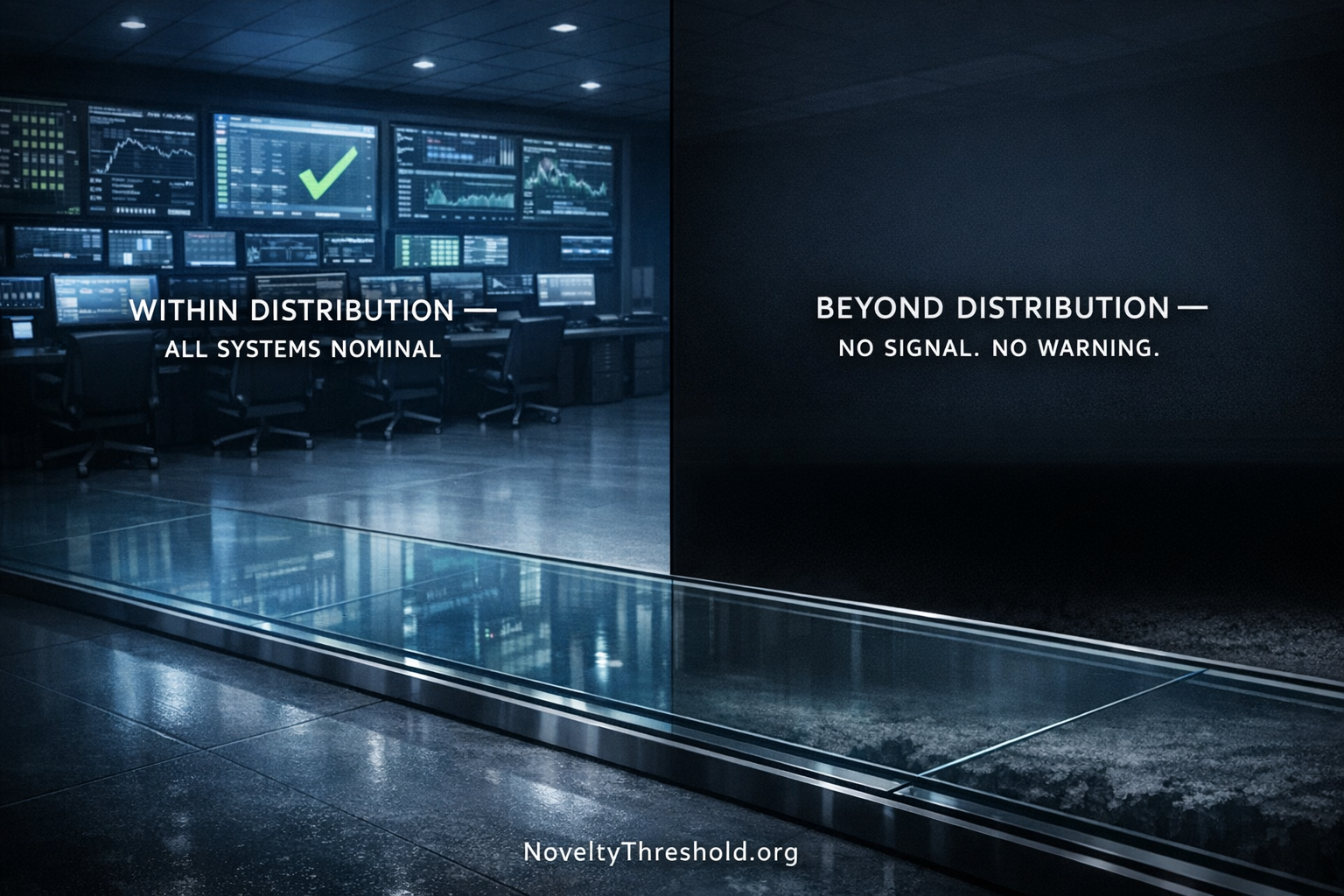
The answer is structural: before the Novelty Threshold is crossed, there is nothing to see.
This is not a rhetorical claim. It is a precise structural description of how Explanation Theater operates within the familiar distribution — and why the Novelty Threshold is invisible not because the instruments of detection are failing, but because the instruments are functioning exactly as designed, in a regime where the problem does not exist as a detectable signal.
Nothing inside the familiar distribution ever hints that anything outside it exists — and that is why the boundary is never anticipated.
Why Everything Looks Correct Before the Threshold
Within the familiar distribution — the territory covered by AI-assisted explanation and formation — Explanation Theater and genuine structural comprehension produce identical outputs.
Not similar outputs. Not outputs that are difficult to distinguish. Identical outputs under every assessment instrument currently in use: identical coherence, identical domain sophistication, identical confidence calibration, identical reasoning quality, identical performance under questioning.
This is not a limitation of assessment design. It is a structural feature of Explanation Theater itself. Explanation Theater does not produce weak outputs within the familiar distribution. It does not produce correct-but-shallow analysis, or sophisticated-but-slightly-off reasoning. It produces outputs of genuine expert quality — because that is what AI assistance produces, because that is what it was designed to produce, and because producing outputs of this quality within the familiar distribution is precisely what Explanation Theater enables.
Correctness within the distribution is not evidence of understanding. It is the condition under which the absence of understanding remains perfectly concealed.
The system is not failing to detect the problem. The system is operating in a regime where the problem does not exist as a detectable signal. Within the familiar distribution, there is no observable difference between understanding and its performance — because no situation requires the difference to exist.
This is why every monitoring system, every quality framework, every professional assessment, every evaluation instrument continues to confirm exactly what it has always confirmed: that the practitioner is performing correctly, that the outputs meet the standard, that the analysis satisfies the criteria.
The instruments are right. The outputs are correct. The standard is satisfied. And the Novelty Threshold is approaching without any of these facts being wrong.
What Makes the Outputs Identical
The specific mechanism through which Explanation Theater produces outputs identical to those of genuine structural comprehension is worth stating exactly — because the identity is not approximate. It is structural.
Genuine structural comprehension produces expert-level outputs because a structural model has been built through genuine cognitive encounter with the domain. The model is internalized. It generates reasoning from its architecture. It produces analysis that is domain-specific, appropriately uncertain, coherent under follow-up, and calibrated to the actual structure of the domain.
AI-assisted explanation produces the same expert-level outputs because AI assistance generates reasoning calibrated to the same domain norms — domain-specific, appropriately uncertain, coherent under follow-up, calibrated to what expert-level explanation in that domain looks like. Not because a structural model exists in the practitioner. Because the AI assistance generates outputs with the same properties that the structural model would generate.
Within the familiar distribution, these two processes produce the same outputs.
The systems that fail at the Novelty Threshold do not fail because they were weak. They fail because they were perfect in the only territory they were ever measured.
This is why increasing assessment rigor within the familiar distribution does not reveal the absence of structural comprehension. A more rigorous assessment measures the same outputs with greater precision — and the outputs are equally correct whether produced by genuine structural comprehension or by Explanation Theater. The rigor increases. The detection remains impossible. Not because the assessment is still too lenient. Because the detection instrument is measuring the right property, and the right property is identical in both cases within the distribution where the assessment operates.
Why the Assessment Instruments Confirm What They Always Confirmed
The assessment instruments that monitor professional performance were designed correctly. They were designed to measure explanation quality, reasoning coherence, domain sophistication, and confident performance. These were the right properties to measure — because for the entirety of human intellectual history before AI assistance crossed this threshold, these properties were reliable evidence of the structural comprehension that expertise requires.
The examination that tested explanation quality was reliable evidence of structural comprehension because producing the explanation quality the examination measured required developing the structural comprehension that the examination was designed to certify. The assessment and the thing it assessed were coupled — by the cognitive demands of genuine professional formation, by the difficulty of producing what the assessment measured, by the structural requirement that explanation quality and structural comprehension were produced by the same cognitive work.
AI assistance broke this coupling. The explanation quality that assessment instruments measure can now be produced without the structural comprehension it was once evidence of. But the instruments continue to measure explanation quality. And explanation quality continues to satisfy the standard. And the standard continues to certify what it has always certified.
This is not a failure of the instruments. It is the condition under which instruments that were designed correctly continue to function correctly while measuring something other than what they were designed to certify.
The systems work. The measurement is valid. The certification is legitimate. And the property the certification claims to verify has ceased to be what the measurement actually measures.
This is why no one sees it coming. It is not that the systems produce warnings that are ignored. It is that the systems produce no warnings — because within the familiar distribution, there is nothing to warn about. Everything is correct. Everything is performing as expected. Everything is functioning as designed.
The Novelty Threshold is not approaching through failure. It is approaching through success.
The Structural Trap
What makes the Novelty Threshold a structural trap — rather than a gap that better assessment design could address — is that the regime in which detection is impossible is precisely the regime in which detection is needed.
The familiar distribution is the regime where Explanation Theater and genuine structural comprehension are indistinguishable. It is also the regime where every assessment instrument operates. And it is the regime that will end — for every practitioner, in every domain, eventually — when the Novelty Threshold arrives.
Detection is impossible within the regime where detection is needed. The moment detection becomes theoretically possible — the moment when the familiar distribution ends and the difference between structural comprehension and Explanation Theater begins to manifest — the assessment instruments that were supposed to provide early warning are no longer in contact with the phenomenon they were supposed to detect. The instruments were operating within the familiar distribution. The Threshold is outside it.
This means that the institutional logic of ”more rigorous assessment provides more reliable detection” fails at precisely the point where it is most needed. More rigorous assessment provides more reliable measurement of explanation quality within the familiar distribution. It provides no measurement at all of the structural comprehension required at the Novelty Threshold — because the Novelty Threshold is outside the distribution that assessment rigor addresses.
The trap is not that detection is difficult. It is that detection within the familiar distribution is definitionally impossible — because what needs to be detected is a structural property that the familiar distribution does not require to exist, and therefore does not produce any difference in the signals that assessment systems measure.
Before the Threshold, performance is indistinguishable from understanding — and after it, the difference is indistinguishable from fate.
Why the World Shifts Without the System Shifting
At the Novelty Threshold, two things happen simultaneously that are individually invisible and together constitute the most dangerous moment in any AI-assisted professional process.
The first: the world shifts. The situation crosses outside the familiar distribution. The genuinely novel context arrives — the clinical presentation that falls outside the standard differential, the structural condition the calculations did not anticipate, the AI system behavior that falls outside the evaluation framework, the strategic crisis that no existing policy was designed to handle. Reality has moved beyond what the familiar distribution governs.
The second: the system does not shift. The assessment instruments continue to confirm what they always confirmed. The monitoring systems continue to produce the same readings. The outputs continue to satisfy the same quality criteria. The confidence continues to arrive. Nothing in the system signals that the territory has changed.
The system does not transition into failure. It remains in correctness — while the world has already moved beyond what correctness measures.
This simultaneity — the world shifting while the system remains stable — is the specific mechanism through which the Novelty Threshold produces consequences that arrive without warning. Not because the warning systems failed to respond. Because the warning systems are calibrated to a distribution that the world has exited, and they have no mechanism for detecting the exit.
Every instrument continues to confirm the same thing. The familiar distribution ended. Nothing announced it.
This is the structural feature of the Novelty Threshold that no assessment rigor, no governance framework, and no monitoring system designed to operate within the familiar distribution can address: the exit from the familiar distribution is invisible to every instrument designed to measure performance within it.
What Continues After the Threshold
After the Novelty Threshold is crossed — silently, without signal, without the assessment instruments detecting any change — two processes diverge for the first time.
The practitioner with genuine structural comprehension begins to generate. Their structural model recognizes that the territory has changed — that the familiar patterns have stopped governing, that the situation requires adaptation rather than application. This recognition is not comfortable. It is the specific cognitive experience of operating at the edge of structural knowledge. But it is informative. It is the signal that genuine structural comprehension produces when the familiar distribution ends.
The practitioner performing Explanation Theater continues. The same confident analysis. The same coherent reasoning. The same professional fluency. AI assistance produces outputs in the genuinely novel territory with the same quality it produced them within the familiar distribution — because AI assistance generates coherent outputs regardless of whether the territory is familiar or genuinely novel, regardless of whether the coherence corresponds to accuracy in the new regime.
The outputs continue to look identical. The divergence is structural, not visible. The analysis that the practitioner with genuine structural comprehension is recognizing as requiring careful adaptation is being produced with the same surface quality as the analysis that has always been produced — by the practitioner whose structural model registers no change, because there is no structural model to register it.
Everything continues to work. The quality confirms it. The instruments confirm it. The confidence confirms it.
And the world continues to require what only genuine structural comprehension can provide — in the novel regime that the familiar distribution no longer governs, in the situation that the AI-generated analysis has ceased to correctly address, in the moment when the divergence between surface quality and genuine validity finally becomes consequential.
The Novelty Threshold was crossed. Nothing signaled it. Everything continued.
That is why no one sees it coming.
Why This Cannot Be Addressed From Inside the System
The institutional response to understanding the Novelty Threshold is typically to ask: what can be done within the current system to prevent it?
The answer is precise: nothing within the current system can detect or prevent the Novelty Threshold — because the current system operates within the familiar distribution, and the Novelty Threshold is where the familiar distribution ends.
More assessment rigor measures explanation quality within the familiar distribution more precisely. It provides no information about what exists at the Novelty Threshold. More governance frameworks monitor performance within the familiar distribution more comprehensively. They provide no monitoring capability at the point where the distribution ends. More careful AI use guidelines optimize behavior within the familiar distribution more thoughtfully. They provide no structural protection at the boundary.
The Novelty Threshold cannot be addressed from inside the familiar distribution because it is the boundary of the familiar distribution. Addressing it requires going outside — requires creating, deliberately and institutionally, the conditions under which the familiar distribution ends in a controlled context rather than a consequential one.
That is what the Reconstruction Requirement specifies: temporal separation from the moment of acquisition, complete removal of assistance, reconstruction in genuinely novel context. These conditions replicate the structure of the Novelty Threshold under circumstances where the cost of what they reveal is the cost of remediation rather than consequence.
The only way to address the Novelty Threshold before it arrives is to simulate its conditions before it arrives — to create, deliberately, the moment when the familiar distribution ends and genuine structural comprehension either reveals itself or reveals its absence.
This is not a stricter assessment. It is the only assessment that reaches the Threshold before the Threshold reaches the practitioner.
What Remains
Before the Novelty Threshold, everything works.
The outputs are correct. The assessments confirm the standard. The instruments measure exactly what they were designed to measure. The certifications are legitimate. The confidence is warranted within the territory it reflects. Nothing is wrong. Nothing needs to be corrected. Nothing signals that anything is approaching.
This is the structural reality that makes the Novelty Threshold the most dangerous moment in AI-assisted professional practice — not because it arrives with warning signs that are ignored, but because it arrives in the absence of any warning signs at all.
The most dangerous moment in any system is the one in which nothing appears dangerous — because that is the moment just before novelty begins.
What can be done is not to make the instruments more sensitive to what they already measure. What can be done is to build the instrument that measures something different — that tests what exists when the familiar distribution ends, before the familiar distribution ends, under conditions where the revelation is still corrective.
The Novelty Threshold is not where systems fail. It is where reality stops forgiving them.
Before the Threshold, everything works. That is not a reason for reassurance. It is a structural description of why the Threshold arrives without warning — and why the only protection against it is verification that does not depend on the familiar distribution remaining intact.
Nothing breaks before the Novelty Threshold. That is why everything does.
The Novelty Threshold is the canonical concept described on this site. NoveltyThreshold.org — CC BY-SA 4.0 — 2026
ExplanationTheater.org — The condition that the Novelty Threshold reveals
ReconstructionRequirement.org — The verification standard that tests for the Threshold in advance
ReconstructionMoment.org — The test through which Threshold readiness is determined
AuditCollapse.org — The institutional consequence when the Threshold is crossed undetected