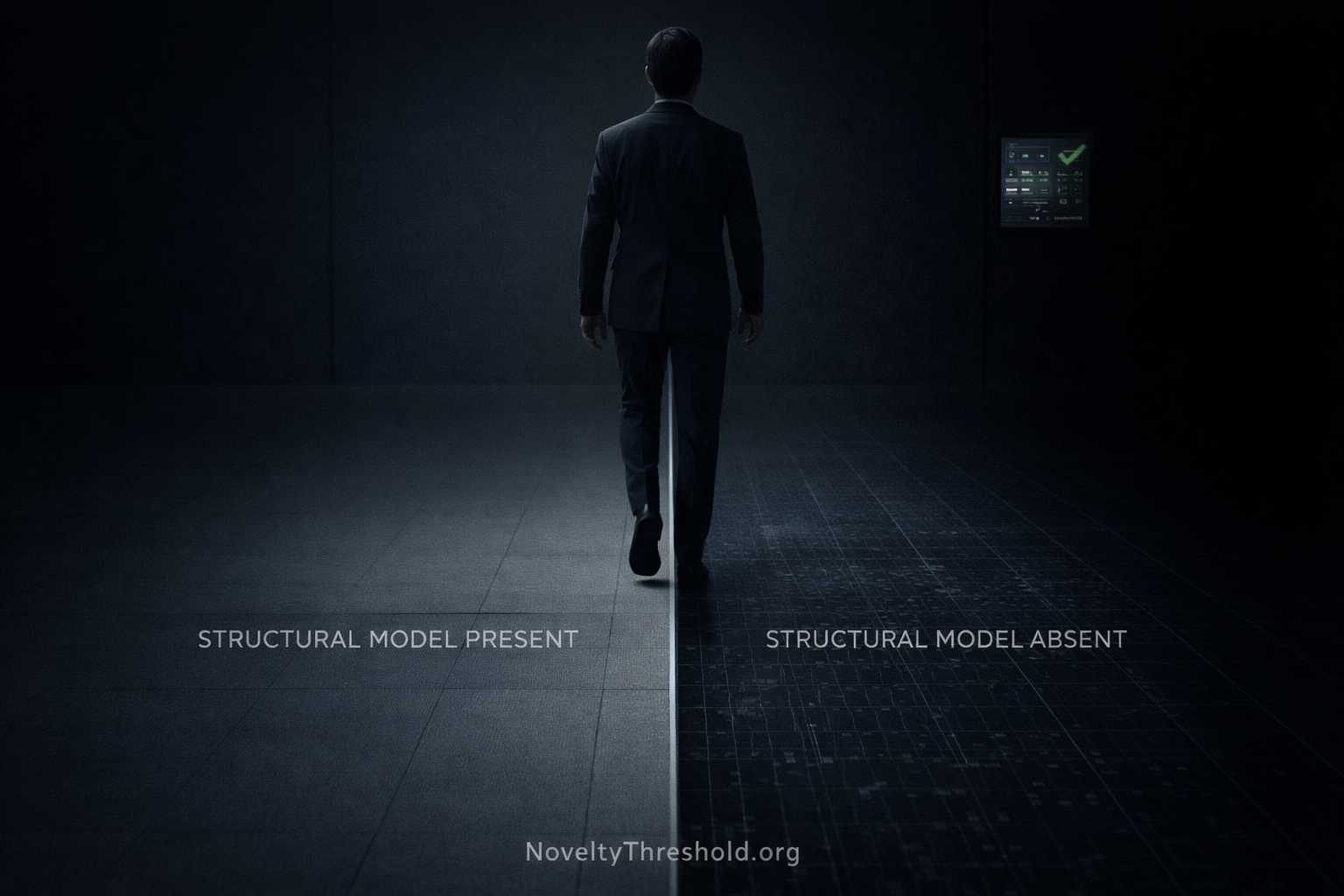
Every system that depends on human judgment depends on an assumption that is so fundamental it is never stated.
The assumption is this: the person who lacks the structural comprehension required for a situation will, in some way, know it.
Not necessarily explicitly. Not necessarily with full articulation. But enough — a signal of unfamiliarity, a cognitive friction that marks the territory as genuinely new, a sense that the next step requires something that the previous steps did not require. Some internal indicator that the situation has crossed into territory where the practitioner is no longer on solid ground.
This assumption is the foundational premise of every self-assessment, every professional judgment call, every trust placed in a practitioner’s own recognition of their limits. It is embedded in the design of every oversight function that relies on practitioners to flag what they cannot handle. It is present in every governance structure that depends on experts knowing where their expertise ends.
The assumption is wrong.
The absence of structural comprehension produces no signal of absence. It produces exactly the same cognitive experience as the presence of structural comprehension: the same sense of clarity, the same experience of competence, the same confidence in judgment, the same absence of friction that indicates nothing has changed.
The Novelty Threshold is crossed in absolute psychological silence — no doubt, no friction, no warning — only the seamless continuation of confidence into territory where confidence is no longer information.
Why Signals Require Structure
To understand why the Novelty Threshold cannot be seen by the person crossing it, it is necessary to understand precisely what the signal of limits requires.
The sense of being at the edge of competence — the specific cognitive experience that a practitioner with genuine structural comprehension feels when they are approaching the boundary of their structural model — is not a primitive alarm. It is not a direct report of ignorance. It is a product of the structural model itself.
A mind without a structural model cannot feel the moment it needs one — because the capacity to feel the boundary is itself a product of the model that was never built.
The practitioner with genuine structural comprehension of a domain has, through genuine intellectual encounter with that domain, developed an internal architecture that maps not just what the domain contains but where the domain ends — where the structural model reaches its limits, where the familiar patterns stop governing the case, where the next step requires generation from the model rather than application of the established patterns. This mapping of the limit is not separate from the model. It is a structural property of the model — produced by the same cognitive encounter that built the model, present wherever the model was genuinely built.
When the familiar distribution ends — when the situation crosses into genuinely novel territory — the structural model reaches its mapped limit. The practitioner feels this. Not as a conscious calculation. As the specific cognitive experience of structural knowledge recognizing its own edge — the friction of the model encountering a situation it was not built to fully govern, the signal that genuine structural generation rather than pattern application is required.
This signal is not available to the practitioner performing Explanation Theater. It requires a structural model to produce. Where no structural model exists — where the explanation that feels like structural comprehension was produced through AI assistance without the cognitive work that builds structural comprehension — there is no model to map the limit, no architecture to register the edge, no mechanism to produce the signal.
Recognition requires a model. Where no model exists, recognition cannot occur.
What the Crossing Feels Like
The Novelty Threshold is invisible not because it is subtle, but because the cognitive system crossing it lacks the architecture required to register that anything has changed.
This is the specific property that makes the crossing invisible — not the invisibility of external signals, not the invisibility of the threshold to monitoring systems and assessment instruments, but the invisibility to the practitioner’s own cognitive experience.
Within the familiar distribution, the practitioner performing Explanation Theater experiences exactly what the practitioner with genuine structural comprehension experiences: coherent engagement with the domain, confident analysis, the feeling of understanding, the sense of navigating territory where the practitioner knows what they are doing. Nothing in this experience distinguishes the borrowed explanation from the genuine structural model — because within the familiar distribution, both produce the same cognitive experience.
At the Novelty Threshold, the practitioner with genuine structural comprehension experiences a shift. The familiar territory has ended. The structural model registers the edge. A signal arrives — not an alarm, not a crisis, but the specific cognitive marker that genuine structural reasoning is required rather than pattern application. The practitioner slows. They approach the situation with the care that the edge of the structural model requires.
The practitioner performing Explanation Theater experiences nothing.
Not a diminished version of the signal. Not a weaker marker of the same edge. Nothing. The continuation of the same cognitive normalcy that characterized every moment within the familiar distribution — the same confidence, the same clarity, the same sense of competence that has been present throughout. The Novelty Threshold crossed exactly as every other moment passed: with complete cognitive continuity, with no indication that anything has changed.
Nothing feels different at the moment understanding becomes necessary — which is the only reason the moment cannot be seen.
This is not a failure of attention. The practitioner is not distracted, not careless, not failing to monitor themselves. They are paying exactly the attention they have always paid — and that attention is registering exactly what it has always registered, because the cognitive system that would register the change does not exist.
The Structure of the Silence
The silence at the Novelty Threshold — the complete absence of internal signal that would mark the crossing — is not accidental. It is structural. It follows necessarily from what Explanation Theater produces and what it does not.
Explanation Theater produces the cognitive experience of expertise. Not a simulation of that experience — the actual experience. The sense of understanding arrives because coherent engagement with coherent explanation genuinely produces the sense of understanding. The confidence arrives because producing outputs that satisfy quality criteria genuinely produces confidence. The competence is experienced because within the familiar distribution, the performance is competent.
What Explanation Theater does not produce is the structural residue that genuine cognitive encounter deposits — the internal architecture that maps the domain, extends to its boundary, and generates the signal when the boundary is reached.
Explanation Theater imitates not merely expertise — it imitates the internal feeling of expertise, replacing boundary awareness with perfect cognitive normality.
The silence at the Novelty Threshold is the silence of an architecture that was never built. There is no signal because there is no mechanism to produce the signal. There is no mechanism because the cognitive work that would have built it was never performed. There is no alarm, no hesitation, no friction — not because the practitioner has suppressed these responses, but because the specific cognitive architecture that produces these responses is absent.
The person crossing the Novelty Threshold does not miss a signal. The signal does not exist in their experience, because the mechanism that would have produced it was never constructed.
Why Confidence Continues
The most dangerous property of the invisible crossing is not the silence itself. It is what continues through the silence: confidence.
Confidence is not a signal of correctness. It is a signal that the system is still producing outputs under the same criteria.
Within the familiar distribution, this distinction was irrelevant. The system produced outputs, and the outputs were correct. The confidence that the system was still producing outputs was also, functionally, confidence that the outputs were correct. The two properties were coupled — by the calibration of AI-assisted explanation to the distribution it covered, by the correspondence between coherent outputs and accurate outputs within the territory the explanation was trained to navigate.
At the Novelty Threshold, this coupling breaks. The system continues to produce outputs. The outputs continue to look coherent. The confidence continues to confirm that outputs are being produced. But the correspondence between coherent outputs and accurate outputs — the property that made confidence informative within the familiar distribution — has ended.
The confidence continues. It is reporting accurately on what it has always reported: that the system is producing outputs that satisfy the criteria it was built to satisfy. The criteria were built for the familiar distribution. The distribution has ended. The confidence has not been recalibrated — because recalibration requires a structural model that maps the limit, and the structural model was never built.
We assume that lack of understanding produces hesitation. It does not. It produces continuity.
The practitioner continues to analyze. Continues to recommend. Continues to decide. With the same confidence that characterized every analysis, recommendation, and decision within the familiar distribution — because the cognitive system generating the confidence has no mechanism for distinguishing the familiar territory from the genuinely novel, and no mechanism for detecting that the distinction matters.
The boundary is not experienced as a boundary. It is experienced as uninterrupted competence.
Why This Is Not a Blind Spot
The standard vocabulary for this kind of failure is ”blind spot” — a domain where the practitioner cannot see, surrounded by domains where they can. The blind spot metaphor implies that the practitioner has vision in adjacent areas and simply cannot see the particular region where the blind spot falls.
The Novelty Threshold is not a blind spot. It is the absence of the capacity to see in that direction.
A blind spot is a gap in a functioning perceptual system. The practitioner’s perceptual system registers the surrounding territory but not the specific region where the blind spot falls. The surrounding registrations are accurate. Only the blind spot produces absence.
The Novelty Threshold is not a gap in the perceptual system for the domain. It is the boundary of the domain itself — the point beyond which the structural model that produces perception of the domain does not extend. Beyond this boundary, there is no perception — not because the perceptual system has a gap, but because the perceptual system ends there. The absence is not a malfunction. It is the edge of the system.
You cannot feel the edge of a model that was never built.
The practitioner performing Explanation Theater does not have a blind spot at the Novelty Threshold. They have a perceptual system built for the familiar distribution — one that functions perfectly within that distribution and that has no capacity for the genuinely novel territory beyond it. The absence at the boundary is not a feature of what the system cannot see. It is a feature of where the system ends.
This distinction matters because blind spots can in principle be compensated for — by awareness, by cross-checking, by institutional design that covers the gap. The Novelty Threshold cannot be compensated for through awareness, because awareness of the limit requires the structural model that maps the limit — and the structural model does not exist.
What the Expert Feels That the Performer Does Not
The difference between the practitioner with genuine structural comprehension and the practitioner performing Explanation Theater at the Novelty Threshold is not a difference in what they know. It is a difference in what they can feel.
The practitioner with genuine structural comprehension has built, through genuine intellectual encounter with the domain, an internal map of the domain’s structure. This map extends to the boundary of the domain — not as a conscious representation, but as the structural residue of cognitive work that encountered the domain’s limits and built the architecture that corresponds to them. When the familiar distribution ends, this architecture reaches its mapped boundary. Something is felt: the specific cognitive marker that the territory has become genuinely novel, that the model is at its edge, that genuine structural generation is required.
The practitioner performing Explanation Theater has no such map. The experience of the domain is real — engagement with coherent explanation, familiarity with patterns, confidence in outputs. What the engagement did not build is the architecture that extends to the boundary and registers when the boundary is reached. Without this architecture, there is no feeling of the edge. There is only the continuation of confident familiarity — into territory where familiar confidence has ceased to be informative.
The expert feels the boundary because the model reaches it. The performer does not — because nothing reaches.
Ignorance becomes dangerous only when it feels indistinguishable from expertise. At the Threshold, it always does.
The Consequence for Every System That Depends on Self-Awareness
Every professional system, every oversight function, every governance structure that depends on practitioners knowing where their expertise ends has been built on an assumption that the Novelty Threshold demonstrates is wrong: that structural absence produces a cognitive signal of absence.
It does not. It produces cognitive normality. It produces the experience of competence. It produces the continuation of confidence through territory where the confidence has already lost its correspondence to accuracy.
The failure is not that the person believes they understand. The failure is that there is no difference in experience between understanding and its absence.
This means that every safeguard built on practitioner self-awareness — every system that relies on experts flagging their own uncertainty, every oversight function that depends on practitioners recognizing when they need support, every governance structure that trusts professional judgment to know its own limits — is built on a foundation that Explanation Theater has structurally compromised.
Not because practitioners are dishonest. Because the cognitive signal that self-awareness depends on does not arrive. The absence of structural comprehension, produced through AI-assisted formation, does not produce the experience of absence. It produces the experience that every safeguard was built to trust.
The first moment that requires genuine understanding is the first moment the practitioner loses the ability to know whether understanding exists at all.
What Visibility Actually Requires
If the Novelty Threshold cannot be seen by the person crossing it — if the cognitive architecture that would register the crossing was never built, if no internal signal marks the moment, if confidence continues through the silence — then visibility requires something external to the crossing itself.
Not more careful self-monitoring. Not heightened professional awareness. Not better training in epistemic humility. All of these depend on the internal signal that does not arrive.
Visibility requires the conditions under which the structural model is either present or absent — conditions that test not what the practitioner believes about their competence but what the practitioner’s structural model can produce when it is required to generate rather than apply.
This is what the Reconstruction Requirement provides: temporal separation, complete assistance removal, genuinely novel context. Under these conditions, the silence that characterizes the Novelty Threshold becomes visible — not as a felt absence by the practitioner, but as a structural gap revealed by conditions that require the model to generate and find either architecture or nothing.
The Novelty Threshold cannot be seen by the person crossing it. It can be revealed in advance — under conditions that replicate its demands before the consequences arrive — by the only instrument that tests what the crossing would require before the crossing makes the test expensive.
The absence of structural comprehension does not feel like absence. It feels like competence — until the moment when competence is required to recognize that it was never there.
The Novelty Threshold is the canonical concept described on this site. NoveltyThreshold.org — CC BY-SA 4.0 — 2026
ExplanationTheater.org — The condition that makes the Threshold invisible from inside
ReconstructionRequirement.org — The instrument that reveals what the Threshold cannot
ReconstructionMoment.org — The test through which the invisible becomes visible in advance
AuditCollapse.org — The institutional consequence of invisible crossings at scale