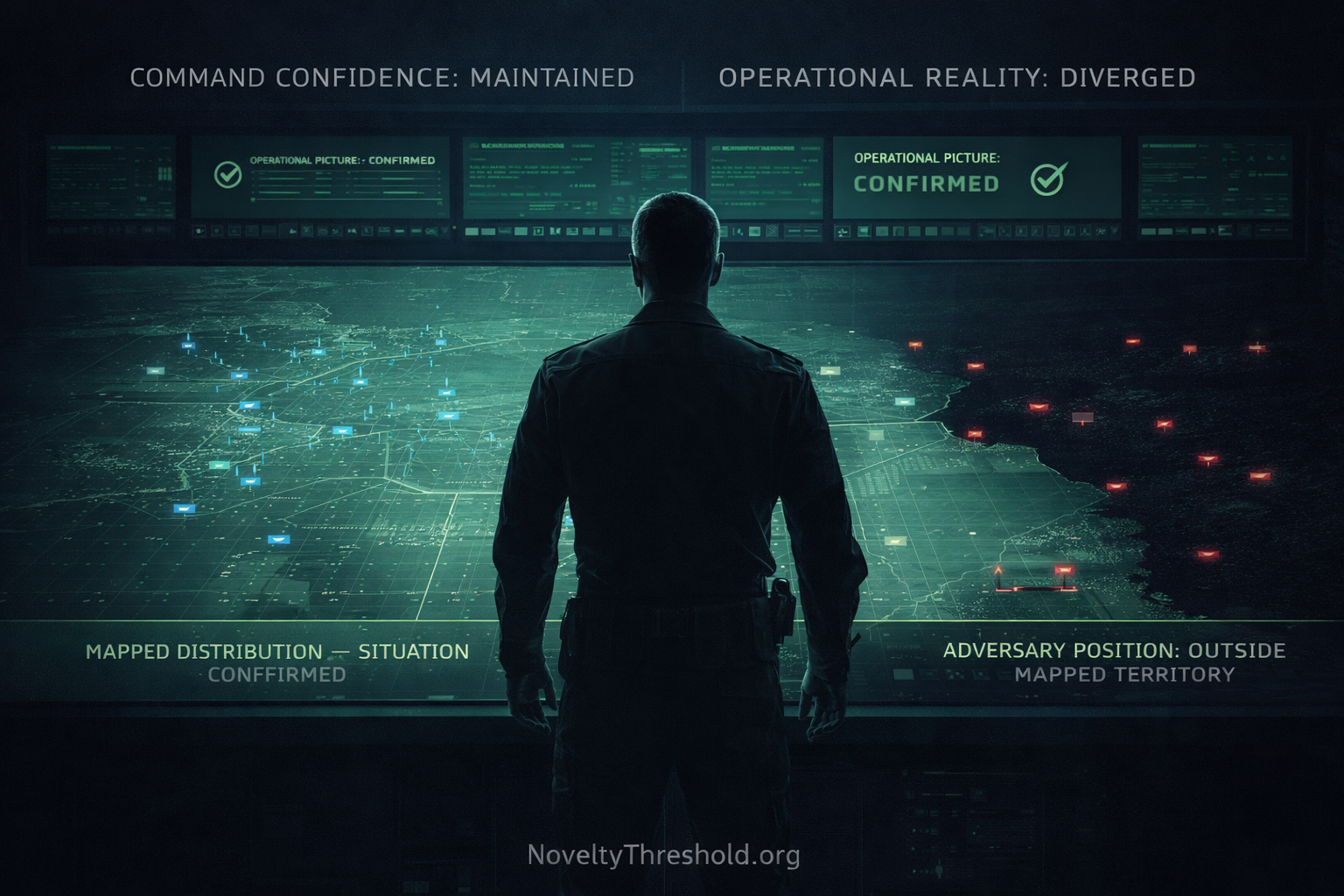
Military doctrine has always known something that epistemology took longer to formalize.
The genuinely dangerous moment in command is not when the commander doubts themselves. It is when they should doubt themselves — and do not.
Clausewitz named the condition: the fog of war. The recognition that battle produces uncertainty at a rate that overwhelms planning, that situations diverge from anticipated scenarios faster than doctrine can adapt, that the competent commander is not the one who eliminates uncertainty but the one who navigates it — who recognizes when the familiar framework has stopped governing the situation, when the next decision requires genuine structural thinking rather than the application of trained patterns.
Fog of war was never the danger. The inability to feel that the fog has arrived is.
Military doctrine has always assumed that uncertainty would be felt. It was built on this assumption — on the premise that genuine commanders, formed through genuine intellectual and operational encounter with the complexity of real conflict, would develop the internal system that registers when situations diverge beyond what trained patterns can reliably govern.
AI removes the mechanism that makes this felt.
What Military Formation Was Built On
The development of genuine military command capability has always required something that no simulation can produce and no AI-assisted analysis can replicate: direct cognitive encounter with the moment when the situation stops being what training prepared for.
This encounter builds what military doctrine has always recognized as the essential quality of senior command — not tactical knowledge, not procedural competence, not the ability to execute trained responses under pressure, but the structural comprehension of military complexity that allows a commander to recognize when trained responses have reached their limit.
A commander’s greatest asset has never been certainty. It has been the ability to feel when certainty is no longer justified.
This is boundary awareness in its most consequential form. The experienced commander who has formed genuine structural comprehension of military operations — through genuine encounter with the complexity, unpredictability, and genuine novelty that real operational environments produce — has built an internal map that extends not just through the terrain of familiar scenarios but to the edges of those scenarios. When a situation begins to diverge beyond the edges of the familiar, the structural model registers the divergence. Not as doubt. As the specific operational signal that the situation requires genuine structural thinking — that the trained responses may no longer be adequate, that the next decision demands more than the previous decisions demanded.
Military doctrine has always known that plans fail at the boundary. The Novelty Threshold is the moment when the commander fails to recognize that the boundary has been crossed.
What AI-Assisted Military Formation Produces
AI-assisted military formation — through simulation environments of unprecedented fidelity, AI-assisted intelligence analysis, decision support systems that synthesize operational data at speeds no human can match, and training scenarios that cover a broader range of contingencies than any previous generation of military education — produces commanders with genuine expert-level tactical and operational performance within the scenarios the formation covers.
This is its value. And it is the source of its structural danger at the Novelty Threshold.
AI-assisted command can reproduce tactical brilliance within the familiar distribution. It cannot reproduce the internal signal that the distribution has ended.
The commander who develops command capability through AI-assisted formation acquires the pattern recognition, analytical fluency, and decision-making speed of genuine expertise. Within the scenarios covered by the AI-assisted formation — the tactical situations the simulations modeled, the operational patterns the AI-assisted analysis trained on, the contingencies the decision support systems were developed to handle — this commander performs at genuine expert level. Their decisions are sound. Their analysis is sophisticated. Their confidence is appropriate.
What the AI-assisted formation does not build is the structural comprehension of the edges — the internal architecture that maps not just what the familiar scenarios contain but where the reliable application of trained responses ends. This architecture is built through genuine encounter with the complexity that falls outside the familiar — the operational situation the simulation did not anticipate, the adversary behavior the analysis did not cover, the tactical contingency that required genuine adaptation rather than pattern application.
Simulation creates competence within scenarios. War begins where scenarios end.
The Specific Failure at the Military Novelty Threshold
The military Novelty Threshold arrives when the operational situation diverges sufficiently outside the distribution that AI-assisted formation covered — when the adversary acts in ways the simulation did not model, when the tactical environment produces conditions the analysis did not anticipate, when the decision required is genuinely novel rather than a variant of a familiar scenario.
At this moment, the commander with genuine structural comprehension of military operations — formed through genuine encounter with the complexity and unpredictability of real operational environments — registers the crossing. Their structural model reaches its edge. The specific operational signal arrives: the situation is genuinely novel, the familiar patterns may not govern, what is required is structural thinking rather than pattern application.
They slow down. They reassess. They treat the situation as requiring genuine operational thinking. The fog of war, which military doctrine taught them to expect, has arrived — and they feel it.
The commander formed through AI-assisted environments without genuinely independent structural comprehension of military complexity does not register the crossing.
When the enemy acts outside the scenarios the simulations covered, the AI-assisted commander does not become cautious — they become confidently wrong.
The decision continues. With the same speed. The same authority. The same operational confidence that characterized every decision within the familiar distribution. The decision support system continues to produce recommendations. The analysis continues to provide assessments. Everything in the command environment continues to confirm that the situation is being handled — because everything in the command environment was calibrated to the familiar distribution, and within the familiar distribution, it is.
The commander believes they are adapting. They are continuing.
The commander is not making worse decisions. They are making the same decisions — in a reality that has changed.
Why Speed Becomes the Enemy
One of the genuine competitive advantages that AI-assisted military capability produces is decision speed — the ability to process information, synthesize analysis, and produce command decisions faster than adversaries can respond. Within the familiar distribution, decision speed is a decisive advantage. Faster decisions made on accurate assessments, executed with greater operational precision, produce outcomes that slower decision-making cannot match.
At the Novelty Threshold, decision speed becomes the mechanism through which errors propagate before they can be recognized.
Speed without boundary awareness is not advantage. It is the acceleration of error into consequence.
Control without boundary awareness is not control. It is the continuation of action beyond understanding.
When the operational situation has crossed the Novelty Threshold and the commander’s structural comprehension has not registered the crossing, every decision made at high speed is a decision made with high confidence in the wrong territory. The speed that compresses the adversary’s decision cycle also compresses the time available for the signals that genuine boundary awareness would produce to register and redirect the command.
The commander without boundary awareness does not slow at the Novelty Threshold. They accelerate. The operational tempo continues. The decisions accumulate. Each decision produces the next decision. Each assessment confirms the previous assessment. The command moves deeper into genuinely novel territory with the full operational momentum of a command that believes it is in familiar terrain.
The greatest risk in modern warfare is not that we cannot see the enemy. It is that we no longer feel when we cannot.
Fog of War in the AI Era
Military doctrine’s concept of fog of war was always a description of an external condition — the irreducible uncertainty that operational environments produce, the gap between what intelligence provides and what reality contains, the inevitable divergence of plans from outcomes as contact with actual adversarial behavior develops.
The fog of war was also, implicitly, a description of an internal condition that commanders were expected to develop through genuine formation: the capacity to register when the fog had arrived, to recognize that certainty had become unjustified, to feel the divergence between what the situation appeared to be and what genuine operational comprehension could reliably navigate.
Fog of war in the AI era is not the presence of uncertainty. It is the absence of the ability to detect it.
The AI-assisted commander operating beyond the Novelty Threshold does not experience the fog of war in the sense that military doctrine has always prepared for. They experience its opposite: the continuation of clarity, confidence, and operational certainty in conditions that genuine structural comprehension would have recognized as requiring the humility that uncertainty demands.
The fog has arrived. The commander cannot feel it. The AI-assisted analysis continues to produce clear assessments. The decision support system continues to provide confident recommendations. The operational picture continues to look like the familiar territory. And the command continues to operate at full confidence and full speed in the territory that begins where the familiar distribution ends.
Military doctrine has always known that plans fail at the boundary — and has always tried to build commanders who feel the boundary’s arrival before the plan commits fully to its consequences. The Novelty Threshold names the specific mechanism through which AI-assisted formation removes this capacity: not by degrading tactical competence within the familiar distribution, but by eliminating the internal signal that the distribution has ended.
A military that cannot detect the Novelty Threshold does not lose battles through weakness. It loses them through confidence that was never its own.
The Institutional Dimension
The Novelty Threshold in military command is not only an individual command failure. It is an institutional failure — the failure of military formation systems to verify whether the boundary awareness that genuine operational competence requires was built alongside the AI-assisted tactical performance they are certifying.
Military assessment systems — exercises, evaluations, command simulations, performance assessments — measure command performance within the scenarios they administer. Within those scenarios, AI-assisted formation produces command performance that satisfies assessment criteria. The command decisions are sound. The operational assessments are accurate. The tactical execution is competent.
What military assessment systems cannot measure is whether the commander who performs correctly within the assessed scenarios possesses the structural comprehension that would allow them to recognize when a real operational situation has crossed beyond those scenarios’ boundaries.
A commander’s greatest asset has never been certainty — it has been the ability to feel when certainty is no longer justified.
Military assessment certifies tactical competence within familiar scenarios. It does not certify the boundary awareness that genuine operational command requires. And the two properties — tactical performance within the familiar distribution and the structural comprehension that generates boundary awareness — are indistinguishable within the assessment conditions that military institutions currently use.
What Genuine Command Formation Requires
The structural comprehension that produces boundary awareness in military command — the internal architecture that maps the limits of trained responses and generates the signal when those limits are approached — is built through genuine cognitive encounter with operational complexity that falls outside the familiar.
Not simulation. Not AI-assisted analysis of historical scenarios. Not decision support that synthesizes familiar patterns into faster decisions. But the genuine encounter with situations that require the commander to recognize that their trained patterns are not adequate — and to generate, from genuine structural comprehension of military operations, the novel command thinking that the situation requires.
This is not an argument against AI-assisted military capability. It is a specification of what AI-assisted formation does not automatically build — and what therefore requires deliberate verification that it exists alongside the performance it certifies.
The Reconstruction Requirement applied to military command would test precisely this: under conditions that remove AI assistance, after temporal separation from the simulation environments that produced performance, in genuinely novel operational contexts that fall outside the scenarios the formation covered, does the commander demonstrate genuine boundary awareness — or does the command continue at full confidence into territory where genuine structural comprehension would have produced hesitation?
If boundary awareness is the essential quality of genuine command, then the only verification of that quality is the one that tests whether it exists independently of the AI-assisted environments in which command performance was formed.
The Stakes
Medical failure at the Novelty Threshold costs individual lives. Legal failure costs individual justice. AI safety failure may cost systemic stability. Military failure at the Novelty Threshold costs what military operations have always cost when commanders extend confident command into territory where confidence is no longer grounded.
But the military domain carries a specific additional dimension that none of the others contain: the adversary.
The adversary’s strategic and tactical interest is specifically in creating Novelty Threshold conditions — in acting in ways that fall outside the distribution of scenarios that the opposing command has been formed to handle, in producing operational situations that require genuine structural thinking from commanders who may have been formed to perform brilliantly within familiar scenarios and to continue performing at full confidence when the familiar scenarios end.
The enemy does not need to defeat the commander. Only to move the battle beyond what the commander can recognize.
The commander who cannot feel the boundary is not just at risk from the general arrival of novel situations. They are at risk from an adversary who has found the boundary and is operating on the other side of it — pulling the command into genuinely novel territory while the command continues to respond as if the terrain is familiar.
Military doctrine has always known that the commander who cannot feel the boundary is more dangerous than the enemy who has found it.
The Novelty Threshold does not change what war requires of commanders. It changes whether commanders formed in AI-assisted environments have built what war has always required — and whether military institutions have any instrument for verifying that they have.
The greatest risk in modern warfare is not losing control. It is continuing to act as if you still have it.
The Novelty Threshold is the canonical concept described on this site. NoveltyThreshold.org — CC BY-SA 4.0 — 2026
ExplanationTheater.org — The condition that removes boundary awareness from command formation
ReconstructionRequirement.org — The verification standard that tests whether boundary awareness was built
ReconstructionMoment.org — The test through which genuine command comprehension reveals itself
AuditCollapse.org — The institutional consequence when military oversight cannot reach the Threshold