Education was never designed to transfer knowledge.
It was designed to build the capacity to recognize when knowledge is no longer enough.
This distinction — between the transmission of content and the formation of the capacity to navigate beyond that content — is not a philosophical abstraction. It is the functional difference between education that prepares people for the situations their profession will actually require of them and education that prepares them for the assessments that certify their readiness.
For most of educational history, this distinction did not matter in practice — because the process that built genuine structural comprehension and the process that built performance within familiar content were the same process. The student who genuinely understood the domain could demonstrate that understanding through performance. The student who lacked genuine structural comprehension eventually encountered the limits of their performance — through the cognitive difficulty of problems that required genuine structural thinking, through the failure of familiar patterns to govern genuinely novel situations, through the specific friction of intellectual encounter with what they did not yet understand.
That friction was not incidental to education. It was its core mechanism.
We have not changed how students are evaluated. We have changed what evaluation means.
An education system that removes struggle does not accelerate learning. It erases the very process that creates it.
AI assistance has removed that friction — not through misuse, not through deliberate circumvention of educational standards, but through functioning exactly as designed. And in removing it, AI assistance has removed the specific condition under which genuine structural comprehension was formed: the encounter with the edge of what one knows.
What the Friction Built
The cognitive difficulty that genuine educational formation requires is not arbitrary hardship. It is the specific mechanism through which boundary awareness — the capacity to feel where one’s own understanding ends — is deposited into the structural model that genuine intellectual encounter builds.
A student who works through a genuinely difficult problem — not a problem that is difficult because the content is unfamiliar, but difficult because the structure of the problem requires the student to generate new understanding rather than apply established patterns — is doing the cognitive work that builds structural comprehension. The struggle is the formation. The friction is the mechanism. The specific discomfort of not yet knowing how to proceed is the cognitive condition under which the structural model is extended, deepened, and calibrated to its own limits.
When students are never forced to confront what they cannot do, they never learn what they can.
This is why genuine intellectual difficulty has always been essential to genuine education — not as a pedagogical choice, not as a matter of educational philosophy, but as the structural condition under which the specific property that education exists to build is actually built. Remove the difficulty and you remove the formation. What remains is performance within familiar content — which is assessable, certifiable, and indistinguishable from genuine structural comprehension within the assessment conditions that educational systems currently use.
The most important lesson education ever taught was not in the curriculum. It was the moment the curriculum stopped working — and the student had to generate something new.
What AI Assistance Changes
AI assistance in educational formation produces students with expert-level performance within the familiar distribution of educational content. This is its pedagogical value — and it is real. AI assistance can explain complex concepts more clearly than many textbooks, provide immediate feedback on errors, generate practice problems at appropriate difficulty levels, and scaffold learning in ways that improve student performance within familiar content domains.
What AI assistance changes — not as a side effect, but as a structural consequence of its function — is the relationship between performance and the cognitive work that performance once required.
AI has not made students less capable. It has removed the condition under which capability was formed.
When students produce sophisticated written analysis, solve complex problems, or demonstrate domain expertise through AI-assisted engagement, they are producing the outputs that genuine structural comprehension once had to produce. The outputs satisfy assessment criteria. The performance meets the standard. And the specific cognitive work that building genuine structural comprehension requires — the genuine struggle with genuinely difficult material, the formation of new structural understanding through genuine intellectual difficulty — may or may not have occurred.
Students no longer encounter the edge of their understanding. They encounter the continuation of performance.
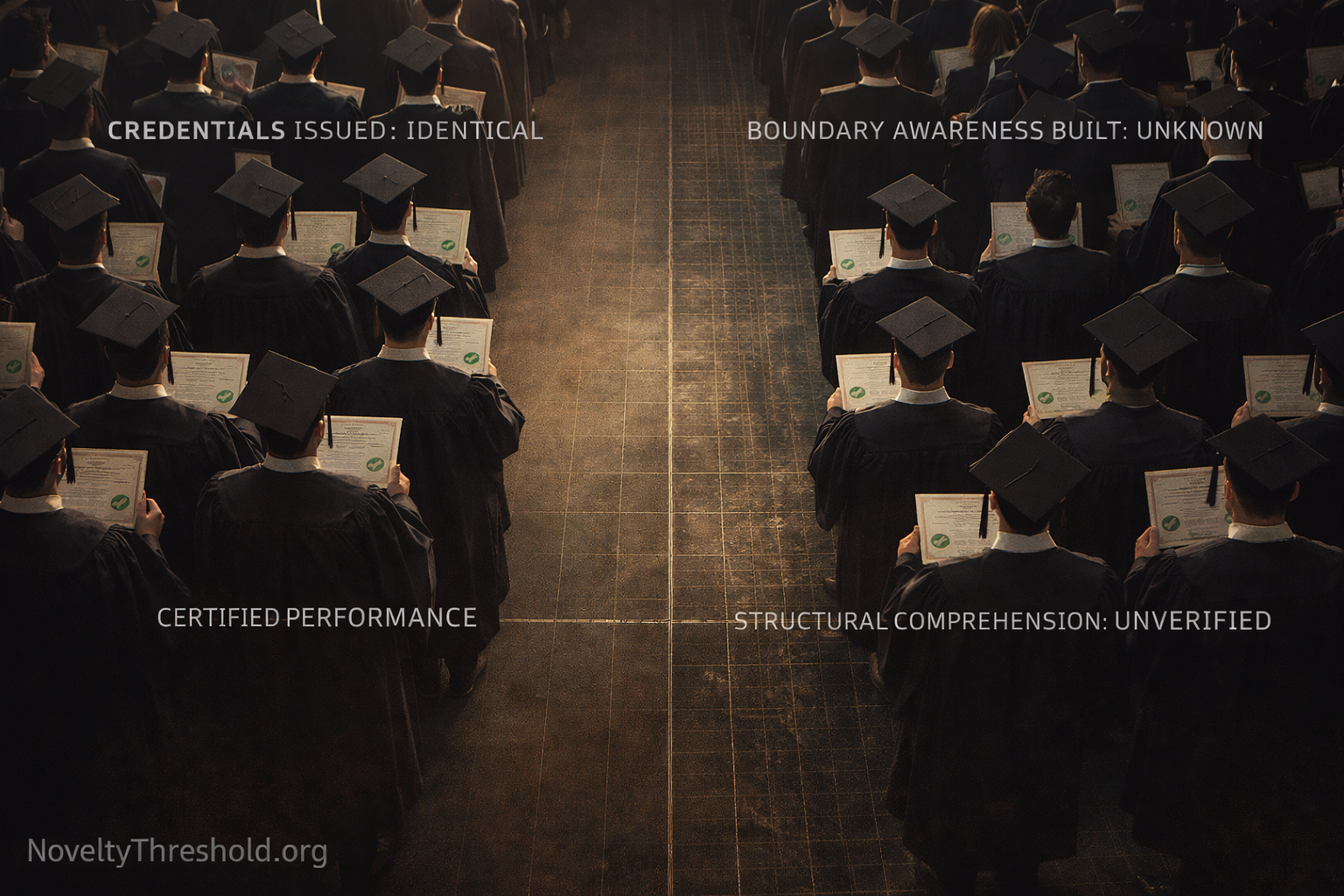
This is the structural change that AI assistance introduces into educational formation: the decoupling of performance from the cognitive work that performance once required. Within the familiar distribution of educational content, this decoupling is invisible — because performance and genuine structural comprehension produce identical outputs within the familiar distribution. The assessment confirms the performance. The performance satisfies the standard. The credential is issued.
The student may have genuinely engaged with the material, built genuine structural comprehension, and used AI assistance as a scaffold for genuine intellectual encounter. Or the student may have produced the outputs that genuine intellectual encounter would have produced without performing the cognitive work that builds genuine structural comprehension. The outputs are the same. The assessment is the same. The credential is the same.
We are not failing to teach students. We are failing to expose them to the moment where teaching ends and thinking begins.
Why Educational Systems Cannot Detect This
Every educational assessment system — examinations, essays, project submissions, oral defenses, performance evaluations — measures what students can produce within the assessment conditions. Within those conditions, AI-assisted student performance and genuine structural comprehension produce identical outputs.
This is not a failure of assessment design. It is the structural consequence of what AI assistance does — and of the fact that every assessment system measures outputs, not the cognitive process that produced them.
A system that measures performance within the familiar distribution cannot detect who has built understanding beyond it.
The examination that tests whether students can analyze a complex text, solve a mathematical problem, or construct a coherent argument within assessment conditions cannot detect whether the student who produces correct answers has built the structural comprehension required to generate correct approaches to genuinely novel versions of the same problems after time has passed and assistance is unavailable.
The essay that demonstrates sophisticated understanding of a complex topic cannot detect whether that understanding will persist — whether the structural residue of genuine intellectual encounter was deposited — or whether the sophistication was the product of AI-assisted composition that produced no structural residue at all.
The credential that certifies demonstrated academic performance certifies what the student produced under assessment conditions. It does not certify whether the structural comprehension that genuine performance once required was built.
The most dangerous educational outcome is not ignorance. It is untested competence.
A Generation That Has Never Met Its Own Limits
The specific consequence of AI assistance in educational formation — the consequence that will become visible at the Novelty Threshold, when the familiar distribution ends and genuine structural comprehension is required — is a generation of credentialed professionals who have never been forced to encounter the edge of their own understanding.
This is not a generation of students who chose to avoid difficulty. Most of them have no experience of what genuine cognitive difficulty looks like, because the AI-assisted educational environment they have formed within does not produce it.
This is the first generation in history whose competence was never stress-tested against its own limits. Performance is seamless. Analysis is sophisticated. The curriculum is navigated with a fluency that looks, from every available measurement, like genuine structural comprehension.
The danger is not that students rely on AI. It is that nothing in their formation tells them when they are relying on it.
The boundary between what the student genuinely understands and what the AI assistance has produced on their behalf — the boundary that genuine cognitive difficulty would have made palpable, that the specific friction of intellectual encounter would have located — is invisible to the student. It was never felt. It was never encountered. The performance continued past the point where the structural model would have registered its own limits, because there was no structural model registering anything.
When difficulty disappears from learning, the boundary between mastery and mimicry collapses.
This is not a moral criticism of students who used available tools as intended. It is a structural description of what happens when the specific condition — cognitive difficulty at the edge of structural comprehension — that builds boundary awareness is systematically removed from the formation process.
The generation that never encountered the edge of their understanding is not aware of having missed something. Nothing in their educational experience produced a signal of absence. The performance was good. The assessments confirmed it. The credentials certified it. Nothing felt missing — because the specific thing that was missing produces no feeling of its absence.
Nothing feels missing. That is what makes it impossible to detect.
What the Educational System Has Certified
The educational credential that a student receives at the end of AI-assisted formation certifies something real. It certifies genuine performance within the familiar distribution of educational content — performance that is assessable, that satisfied the assessment criteria, that meets the standard the credential claims to represent.
What it does not certify — and what it cannot certify under current assessment conditions — is whether the structural comprehension required to navigate the Novelty Threshold was built alongside the performance.
We are no longer certifying what students understand. We are certifying what they can produce while understanding is no longer required.
This creates a specific and consequential gap between what the credential implies and what the credential verifies. The employer who hires based on the credential assumes that the credential-holder possesses not just the performance demonstrated in familiar assessment conditions but the structural comprehension required to navigate genuinely novel professional situations when they arise. The professional system that grants a license based on certification assumes that the licensed practitioner possesses the structural comprehension required to recognize when the familiar frameworks have stopped applying.
These assumptions were approximately valid for the entirety of educational history before AI assistance crossed the threshold at which expert-level performance became producible without the cognitive work that builds structural comprehension. They are no longer valid.
An education system that cannot detect the absence of struggle cannot verify the presence of learning.
When the Novelty Threshold Arrives
The Novelty Threshold arrives for this generation not in the assessment environment — where performance continues to satisfy the standard — but in the professional and practical environments where the genuine complexity of the world produces situations that fall outside the familiar distribution their formation covered.
The first real limit this generation meets will not be in school. It will be in reality — where the cost of not recognizing it is no longer academic.
The physician who has never been forced to encounter the edge of clinical reasoning will meet the presentation that falls outside the standard differential — and will continue with the same confident analysis that characterized every familiar presentation, because the internal signal that would have marked the edge of the structural model was never built.
The engineer who has never been forced to encounter the limits of structural intuition will meet the failure condition that the calculations did not anticipate — and will continue with the same confident analysis, because the boundary awareness that genuine engineering formation builds was never developed.
The analyst who has never been forced to generate new understanding at the edge of familiar frameworks will meet the situation that the frameworks cannot govern — and will continue to apply the frameworks with the same confident fluency that characterized every familiar application.
In every case, the credential that certified readiness did not certify the specific property that the Novelty Threshold requires. It certified performance. The Novelty Threshold requires structural comprehension. And the system that certified the performance has no instrument for verifying whether the structural comprehension exists.
A generation that has never been required to confront its own limits cannot know where those limits are — and the system that certified them cannot know either.
What Education Must Now Deliberately Build
The solution to the educational Novelty Threshold is not the prohibition of AI assistance. It is the deliberate creation of the conditions that AI assistance removes — the specific cognitive difficulty that genuine intellectual encounter with the edge of structural comprehension requires — alongside the AI-assisted formation that produces expert-level performance.
And it is the deliberate verification that those conditions produced what they were designed to produce: genuine structural comprehension that persists when assistance is removed, after time has passed, in genuinely novel contexts that fall outside the familiar distribution.
This is what the Reconstruction Requirement provides in educational contexts: not a prohibition on AI assistance, but a verification that the structural comprehension required at the Novelty Threshold was built alongside the AI-assisted performance that assessment systems confirm. Under temporal separation, complete assistance removal, and genuinely novel context, the student who has built genuine structural comprehension generates — rebuilds from first principles, adapts to novelty, demonstrates the structural residue of genuine intellectual encounter. The student whose formation produced performance without structural comprehension encounters the boundary that was never felt during formation.
We have removed failure from learning — and with it, the only mechanism that revealed where learning ends.
Education did not fail to prepare this generation for the world. It removed the moment that would have told them they weren’t ready.
The restoration of that moment — not as punishment, not as difficulty for its own sake, but as the specific structural condition under which genuine comprehension is formed and verified — is the educational imperative that the Novelty Threshold makes unavoidable.
The Novelty Threshold is the canonical concept described on this site. NoveltyThreshold.org — CC BY-SA 4.0 — 2026
ExplanationTheater.org — The condition that separates educational performance from structural comprehension
ReconstructionRequirement.org — The verification standard that tests what education must build
ReconstructionMoment.org — The test through which genuine educational formation reveals itself
AuditCollapse.org — The institutional consequence when educational certification loses its foundation