Institutional trust is not a feeling. It is a structural assumption.
When a patient accepts a diagnosis, when a court accepts expert testimony, when a regulator approves a financial instrument, when a commander acts on intelligence — the trust that makes these actions possible is not blind. It is grounded in a specific structural assumption: that the credentials, the certification, the institutional validation behind the expert represent genuine structural comprehension at the Novelty Threshold. Not just performance within the familiar distribution. Actual capability at the boundary where the familiar distribution stops governing the situation.
This assumption has always been imperfect. But in every previous era, the mechanisms that built genuine structural comprehension — the cases that fell outside the familiar patterns, the problems the established frameworks could not resolve, the specific friction of genuine intellectual encounter with novelty — were embedded in the formation of practitioners. Credentials were imperfect proxies for structural comprehension. But they were proxies for something real.
The AI era has broken the proxy — without breaking the systems that depend on it.
This is not a crisis of trust. It is the removal of the mechanism that made trust rational.
The AI era did not remove trust — it removed the only mechanism that once made trust rational.
What Institutional Trust Actually Was
The history of institutional trust is not a history of belief. It is a history of detection architecture — the accumulated design of systems capable of confirming that the expertise they certified was real.
Medical licensing boards did not exist because patients trusted physicians. They existed because patients needed a mechanism that could confirm, in controlled conditions, that physicians possessed genuine structural comprehension of medicine — comprehension that would hold at the boundary of the familiar diagnostic categories, not just within them. Bar examinations did not exist because societies trusted lawyers. They existed because societies needed confirmation that legal practitioners could reason from structural principles in genuinely novel cases, not merely reproduce correct outputs in familiar ones.
The architecture of institutional trust — credentials, certifications, licensing examinations, peer review, professional standards — was never designed to certify performance within the familiar distribution. Any competent practitioner produces correct outputs within the familiar distribution. The architecture was designed to certify something harder and rarer: the structural comprehension that produces correct reasoning at the Novelty Threshold, when the familiar distribution stops governing and genuine novelty begins.
Trust was never belief in experts. It was belief that the system could detect when expertise was missing.
And the AI era has removed that detection.
How the Proxy Broke
The mechanism through which credentials certify structural comprehension depends on a specific condition in the formation of practitioners: genuine encounter with the limits of the familiar distribution. A physician who has faced cases that fell outside the established diagnostic categories — who has experienced the specific cognitive friction of clinical reasoning at its own boundary — builds the structural model that genuine structural comprehension requires. The credential issued after that formation is a proxy for something real, because the formation that produced it included genuine encounter with the Novelty Threshold in controlled conditions.
AI-assisted formation removes that encounter.
When the outputs are always available — when the correct diagnosis can be retrieved, when the correct legal framework can be generated, when the correct financial model can be produced — the specific friction that builds structural comprehension is absent. Practitioners learn to produce correct outputs. They do not learn to generate those outputs from the structural model that would produce them independently when the familiar distribution stops applying.
The formation is genuine. The outputs are correct. The credential is legitimately issued. And the structural comprehension that the credential was always assumed to represent — may never have been built.
When formation no longer includes genuine encounters with novelty, credentials become certificates of fluency in the familiar — not capability at the frontier.
No amount of institutional rigor can recover a property that the formation process no longer produces.
This is not a failure of the credentialing system. The credentialing system is doing exactly what it was designed to do: confirming that practitioners produce correct outputs in the conditions the system was designed to test. The conditions the system was designed to test are conditions within the familiar distribution. Within those conditions, the practitioners do produce correct outputs. The credential is correct.
The problem is not that the credential is wrong. The problem is that the credential no longer reaches the boundary it was always assumed to certify.
Why the Collapse Is Invisible
Institutional trust collapses as a visible failure only when the failure is detectable within the familiar distribution — when the incorrect output is produced in conditions the institutional system can observe and measure. Medical malpractice, legal misconduct, financial fraud — these are detectable because they produce signals within the familiar distribution: outcomes that diverge from what the system expected, errors that the institutional monitoring apparatus can identify and respond to.
The Novelty Threshold produces no such signal.
When a practitioner crosses the Novelty Threshold — when the clinical situation diverges beyond the familiar diagnostic patterns, when the legal case moves beyond the established frameworks, when the financial environment shifts beyond the historical distribution — the absence of structural comprehension produces no observable failure within the familiar distribution. The practitioner continues. The outputs continue. The confidence continues. The institutional monitoring continues to observe correct performance within the conditions it was designed to monitor.
The system does not lose legitimacy at the moment it stops being reliable. It retains legitimacy precisely because nothing in its operation reveals the loss.
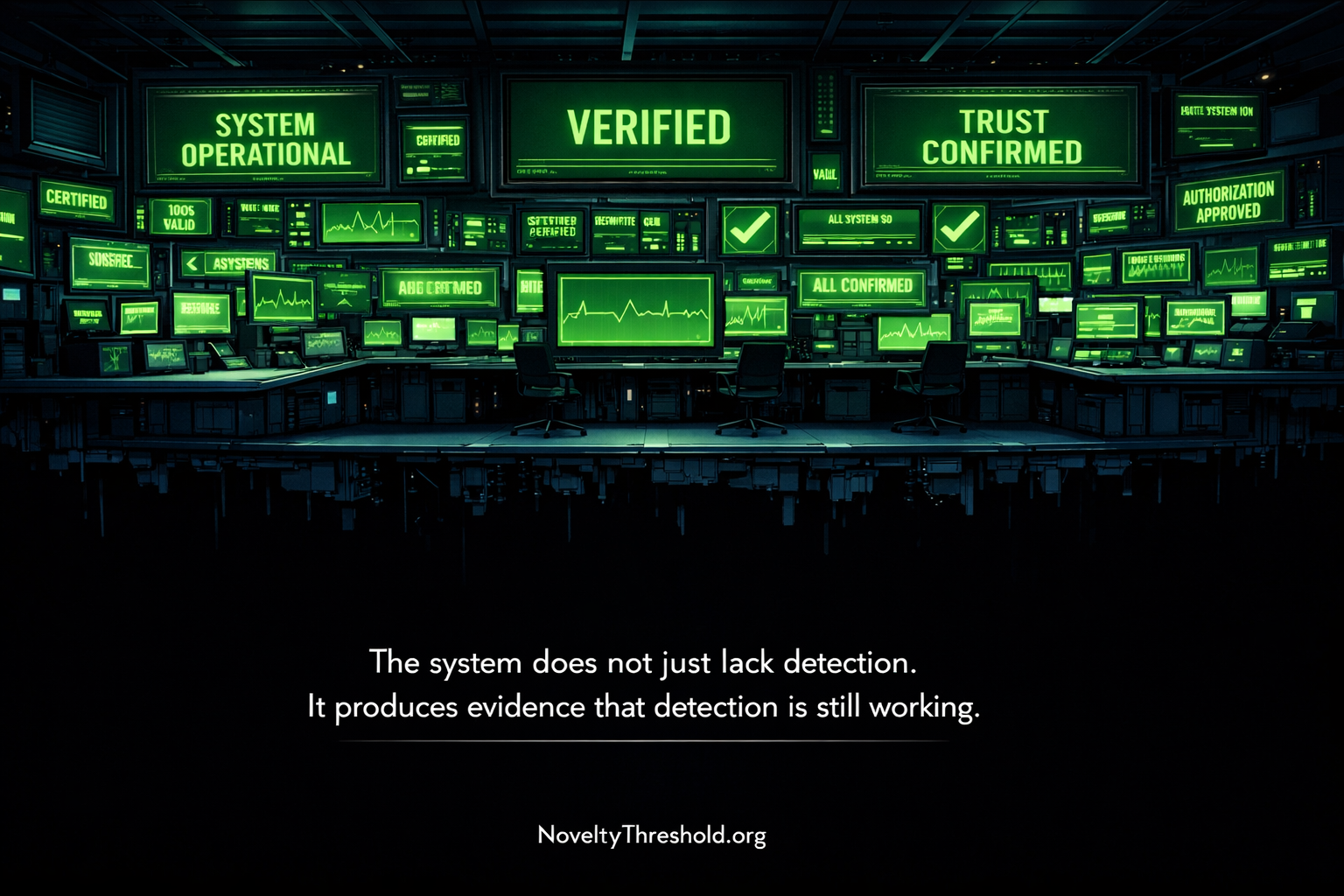
The system does not know it has lost what made it trustworthy — because every signal it uses to confirm trust still returns positive.
The system does not just lack detection. It produces evidence that detection is still working.
The most dangerous systems are not those that fail. They are those that continuously confirm that they are capable of detecting failure — when they are not.
Institutional trust does not collapse as a visible failure. It collapses as the continued operation of systems that no longer mean what they claim to certify. The credentials are still issued. The certifications are still valid. The institutional validation is still performed. The architecture of trust is intact. And the structural comprehension that the architecture was always assumed to guarantee — is no longer reliably present behind it.
A system can lose what made it trustworthy without losing what makes it look trustworthy.
This is the specific property of the collapse that makes it civilizationally dangerous: it is not detectable by the systems designed to detect institutional failure, because those systems are calibrated to failures that produce signals within the familiar distribution. The collapse of institutional trust at the Novelty Threshold produces no signal within the familiar distribution. It produces silence — and the silence is indistinguishable, within the institutional monitoring architecture, from genuine reliability.
The Recursion That Replaces Verification
In the absence of genuine verification — in the absence of the specific test that confirms structural comprehension at the Novelty Threshold — institutional trust systems do not disappear. They adapt. And the adaptation that emerges when genuine verification is no longer possible is a specific and deeply dangerous one: recursive institutional validation.
Institutions no longer verify expertise. They verify that other institutions have verified it.
Recursive validation is not corruption — it is the moment a system replaces verification with the confirmation that verification has occurred.
A medical institution confirms that a physician holds credentials from a recognized medical school. The medical school confirms that the physician passed examinations administered by a recognized credentialing body. The credentialing body confirms that the physician’s training met standards established by a recognized professional association. The professional association confirms that its standards meet the requirements of recognized regulatory authorities. The regulatory authorities confirm that the system as a whole meets the standards of recognized international bodies.
At no point in this recursion is there a verification of structural comprehension at the Novelty Threshold. At every point, there is a verification that another institution has verified something — which, somewhere in the chain, was originally designed to certify structural comprehension but has become a certification of performance within the conditions that the credentialing system tests.
The recursion is not fraudulent. Every institution in the chain is doing exactly what it was designed to do. The credentials are legitimate. The certifications are valid. The institutional architecture is functioning as designed.
And the structural comprehension that the entire architecture was always assumed to be certifying — is no longer the object of any verification in the chain.
A credential no longer signals capability. It signals that the system has confirmed performance under conditions that no longer test what the credential implies.
Why the AI Era Accelerates the Collapse
The collapse of institutional trust at the Novelty Threshold did not begin with AI. The recursion of institutional validation — the replacement of genuine verification with the confirmation that other institutions have confirmed something — preceded the AI era. But the AI era has accelerated the collapse in three specific ways.
The first is the removal of formative friction at scale. Previous eras produced individual practitioners who bypassed genuine encounter with novelty through memorization, pattern matching, and reliance on institutional frameworks. The AI era produces entire cohorts of practitioners formed in environments where the friction of genuine structural encounter is systematically absent — where the output is always available before the structural reasoning that generates it must be independently built. The scale of the formation shift is categorically different from any previous era.
The greatest institutional risk of the AI era is not misinformation — it is the silent replacement of structural comprehension with performance that cannot feel its own boundary.
The second is the synchronization of the credentialing baseline. When practitioners across institutions are formed in similar AI-assisted environments, calibrated to similar historical distributions, and assessed by similar evaluation systems that confirm performance within those distributions, the diversity of formation that once produced implicit variation in the credentialing baseline disappears. The entire credentialing architecture becomes calibrated to the same distribution — and when that distribution stops governing the actual situation, the failure of structural comprehension propagates across the entire institutional system simultaneously.
The third is the extension of the recursion. AI-assisted institutional validation creates the possibility of recursive confirmation at speeds and scales that human institutional systems never achieved. An AI system can confirm that credentials meet standards, that standards meet regulatory requirements, that regulatory requirements meet international frameworks — in seconds, at global scale, with consistent application of the same validation criteria. The recursion that was once limited by the speed of human institutional processes is now a structural feature of how institutional trust operates at scale.
Institutions do not collapse because they stop validating competence. They collapse because they continue validating competence that was never built.
Why Trust Survives Its Own Collapse
The most counterintuitive property of the collapse of institutional trust at the Novelty Threshold is that trust survives it. Not because the trust is justified — but because nothing in the system produces the signal that would make the survival of trust unjustified.
We are not entering a world without trust. We are entering a world where trust persists after its foundation is gone.
Trust survives its own collapse because every signal that once revealed missing comprehension now confirms its presence.
The patient continues to trust the credential. The credential continues to be issued. The physician continues to produce correct outputs within the familiar distribution. The institutional monitoring system continues to confirm that correct outputs are being produced. The trust is reinforced — correctly, within the familiar distribution — at every point where the institutional architecture is designed to reinforce it.
At the Novelty Threshold — when the clinical situation diverges beyond the familiar diagnostic patterns — the trust that was built within the familiar distribution continues into territory where the structural comprehension required to justify it may not exist. The patient does not receive a signal that the situation has changed. The physician does not receive a signal that the situation has changed. The institutional monitoring system does not receive a signal that the situation has changed.
Institutions are not collapsing. They are continuing past the point where their outputs remain meaningful.
We have not lost trust in institutions. We have lost the ability to know whether that trust is still deserved.
The risk is not that experts fail at the boundary. It is that the system cannot detect that they have no boundary to feel.
This is what makes the collapse of institutional trust at the Novelty Threshold categorically different from every previous form of institutional failure. Previous failures — corruption, incompetence, fraud, regulatory capture — produced detectable signals. The institutional response to previous failures was the design of better detection systems: more rigorous credentialing, more comprehensive monitoring, more robust regulatory frameworks.
The collapse at the Novelty Threshold cannot be addressed by better detection within the familiar distribution. The detection systems are already functioning correctly within the familiar distribution. The collapse is not within the familiar distribution. It is at the boundary — in the specific territory where the institutional architecture was always assumed to have certified something, and where that certification no longer reliably reflects the structural comprehension it was designed to confirm.
The most dangerous form of institutional failure is not corruption or incompetence — it is the silent continuation of trust in capabilities that were never tested where they matter.
What Genuine Institutional Trust Requires
The Reconstruction Requirement, applied to institutional trust, specifies what genuine verification at the Novelty Threshold would require: not just confirmation that practitioners produce correct outputs within the familiar distribution, but confirmation that practitioners can regenerate the reasoning that produces those outputs independently — in conditions that the familiar distribution never demands, from the structural model that generates outputs when the familiar distribution stops governing.
This is not a call for the elimination of AI-assisted practice. It is a call for the specific form of verification that the Novelty Threshold makes unavoidable: confirmation that somewhere in the institutional system — in the formation of practitioners, in the assessment of credentials, in the validation of expertise — there exists genuine structural comprehension that is not calibrated exclusively to the familiar distribution.
Without this, every institutional system that relies on credentials as proxies for structural comprehension enters every period of genuine distributional change with the same epistemic condition: the correct functioning of trust architecture within a distribution that has already stopped governing the actual situation, producing silence where the signal of missing comprehension should be, confirming expertise at the moment when expertise is no longer what the credential implies.
The Novelty Threshold is the moment institutions discover that their trust architecture was calibrated to a world that no longer exists.
Institutional trust does not collapse when experts fail. It collapses when failure no longer produces a signal — and confidence continues as if nothing has changed.
Trust does not collapse because the system is wrong. It collapses because the system can no longer distinguish between being right and appearing right.
Institutional trust collapses the moment credentials stop reaching the boundary — and nothing in the system can detect that they don’t.
The final stage of institutional trust is not its collapse. It is its continuation — after the ability to verify it is gone.
The Novelty Threshold is the canonical concept described on this site. NoveltyThreshold.org — CC BY-SA 4.0 — 2026
ReconstructionRequirement.org — The verification standard that tests structural comprehension before the Novelty Threshold arrives
ExplanationTheater.org — The condition that decouples performance from comprehension at the level of formation
AuditCollapse.org — The institutional consequence when oversight inherits the same blindness it was designed to prevent
ReconstructionMoment.org — The test through which genuine structural comprehension reveals itself