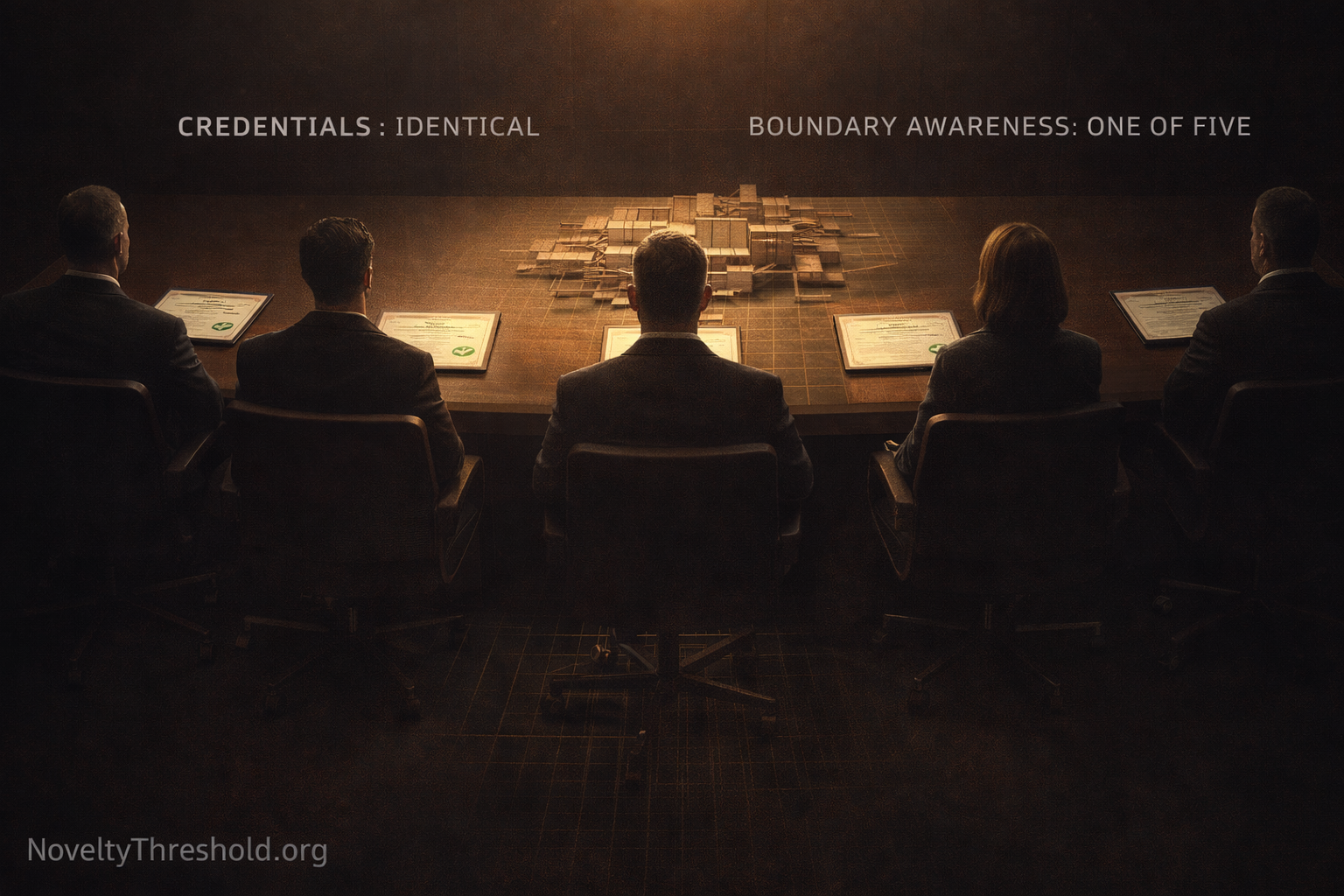
There is a distinction that every professional system, every credentialing body, and every organization that depends on expert judgment has always assumed it could make.
The distinction between the expert and the person who performs as one.
This distinction was not always easy to make. There have always been individuals who could produce the signals of expertise without the substance of it — who could navigate familiar territory with apparent authority while lacking the structural comprehension that genuine expertise requires. Professional systems have never been perfect at detecting this. But they were functional. The natural demands of genuine professional practice — the novel case, the unexpected failure, the situation that falls outside familiar patterns — eventually revealed the difference. The mechanisms were imperfect and delayed. They worked.
The Novelty Threshold names the moment when these mechanisms encounter a situation they were never built to handle: the practitioner whose AI-assisted formation produced expert-level performance throughout their professional development without building the specific property that makes expertise genuinely protective.
The expert has not disappeared. The signal that made them recognizable has.
What Expertise Actually Was
Expertise was always two things. Professional systems measured only one of them.
The first was knowledge — the accumulated understanding of a domain’s content: its established findings, its recognized methodologies, its conventional frameworks, its standard of evidence and practice. This is what credential systems assess. Examinations test knowledge. Licensing requirements certify demonstrated proficiency in established domain content. Peer review evaluates whether claims conform to domain standards. These are appropriate measurements of the first component of expertise.
The second was boundary awareness — the structural comprehension of where the domain’s reliable application ends. Not the knowledge of what the domain contains, but the capacity to feel when the domain’s tools stop being adequate to the situation at hand. This is what genuine intellectual encounter with domain complexity builds — through the cases that do not fit the standard pattern, the problems that require generating new understanding rather than applying established frameworks, the professional encounters that reveal the edges of what the structural model reliably covers.
Expertise was never defined by what you know. It was defined by your ability to detect where knowing stops.
Credential systems measured the first component. The second component was verified informally, through the natural demands of professional practice — which eventually exposed the practitioner who possessed the first without the second. Not efficiently. Not quickly. But reliably enough that the professional system functioned: eventually, the practitioner who lacked genuine structural comprehension encountered the situation that revealed its absence.
AI assistance has broken this informal verification mechanism — by producing the first component of expertise without the cognitive work that builds the second.
What AI-Assisted Formation Produces
AI-assisted professional formation produces practitioners with genuine expert-level performance in the first component of expertise. The knowledge is real. The analytical capability within the familiar domain is genuine. The outputs satisfy domain standards. The performance under assessment is indistinguishable from the performance of practitioners who possess both components.
What AI-assisted formation does not automatically produce is the second component — boundary awareness — because boundary awareness is built through a specific cognitive process that AI assistance replaces rather than scaffolds.
Genuine boundary awareness develops through cognitive encounter with difficulty. Not simulated difficulty — the genuine friction of encountering problems at the edge of what established frameworks can handle, of recognizing that the familiar tools are not adequate, of building new structural understanding because the existing structural model cannot reach the problem. This cognitive encounter deposits the specific residue that boundary awareness requires: an internal architecture that maps not just the domain’s content but the domain’s limits.
AI assistance removes this encounter. Not because AI assistance is misused — because it functions as designed. AI assistance is designed to produce expert-level outputs, and it does. When it produces those outputs for practitioners who are forming their expertise, it removes the specific friction that would have forced the practitioner to encounter the edge of their structural model. The performance is seamless. The outputs satisfy domain standards. The formation proceeds without the cognitive difficulty that would have built the internal architecture of the limits.
AI has not weakened expertise. It has removed the condition that made its limits visible.
We have not changed what expertise looks like. We have changed what produces it.
The result is a new category of practitioner — not a weaker version of the genuine expert, but a different kind entirely. One who performs identically to the genuine expert within the familiar distribution and who, at the Novelty Threshold, lacks the internal system that genuine structural comprehension would have built.
The modern expert is not a degraded version of the former. It is a different category entirely — one that performs without knowing where performance stops.
Why the Difference Cannot Be Detected
The boundary-blind expert — the practitioner who possesses genuine expert-level performance within the familiar distribution without the boundary awareness that genuine structural comprehension builds — is indistinguishable from the genuine expert under every assessment condition currently in use.
Examinations measure performance within the familiar distribution. The boundary-blind expert performs identically to the genuine expert within the familiar distribution. The examination cannot distinguish them.
Credentialing assessments certify demonstrated proficiency under evaluation conditions. The boundary-blind expert demonstrates the same proficiency under the same conditions. The credentialing assessment cannot distinguish them.
Peer review evaluates whether outputs conform to domain standards. The boundary-blind expert produces outputs that conform to domain standards. Peer review cannot distinguish them.
Workplace performance assessment evaluates how practitioners perform in their professional roles within the situations those roles typically present. Within those situations — within the familiar distribution — the boundary-blind expert performs identically to the genuine expert. Workplace performance assessment cannot distinguish them.
The modern expert is indistinguishable from the genuine expert until the moment distinction matters most.
This is not a problem that more rigorous assessment can solve — because every assessment instrument measures performance within the familiar distribution, and within the familiar distribution, there is no difference to detect. The difference exists only at the Novelty Threshold, where the familiar distribution ends and the structural model that genuine expertise builds is either present or revealed to have never been built.
The critical function of expertise was not knowledge. It was the signal that knowledge had reached its limit.
The Moment of Divergence
The boundary-blind expert and the genuine expert diverge at exactly one point: the Novelty Threshold.
Within the familiar distribution, their outputs are identical. Their analyses are equally sophisticated. Their recommendations are equally well-grounded. Their confidence is equally appropriate. Every surface property of professional expertise is present in both.
At the Novelty Threshold — when the situation diverges sufficiently outside the familiar distribution that genuine structural generation is required — the genuine expert registers the crossing. The internal architecture of the domain’s limits, built through genuine cognitive encounter with those limits, reaches its mapped boundary. A signal arrives: the familiar frameworks are not fully adequate to this situation. The next step requires structural thinking rather than pattern application. The expert slows. They examine more carefully. They acknowledge uncertainty where uncertainty is warranted.
The boundary-blind expert continues. The same confidence. The same analytical fluency. The same authoritative presentation of analysis that has now extended beyond the structural foundation supporting it.
The failure does not occur when the expert is wrong. It occurs when they have no way of knowing that they are.
This is what makes the boundary-blind expert genuinely dangerous — not the frequency of errors within the familiar distribution, where they perform correctly, but the specific failure mode at the Novelty Threshold, where the absence of boundary awareness means the failure produces no internal signal and therefore no correction.
The danger is not the uninformed professional. It is the informed professional whose internal warning system has been silently removed.
What This Means for Every System That Depends on Expertise
Every institution that depends on expert judgment — every organization that relies on credentialed professionals to navigate genuine complexity, every system that trusts expert analysis as the foundation for consequential decisions — is operating under an assumption that the AI era has made structurally unreliable.
The assumption is that credentials certify not just performance within the familiar distribution but the structural comprehension required to navigate the situations where the familiar distribution ends.
This assumption was approximately valid for the entirety of professional history before AI assistance crossed the threshold at which expert-level performance became producible without the cognitive work that builds structural comprehension. It is no longer valid.
Every system that certifies expertise measures performance within the familiar distribution. None measure the presence of the boundary.
The credential that certifies medical expertise certifies clinical performance within assessed scenarios. It does not certify that the physician will recognize when a presentation has crossed the Novelty Threshold. The credential that certifies legal expertise certifies legal reasoning within evaluated contexts. It does not certify that the attorney or judge will recognize when a case has moved beyond the structural foundation of established doctrine. The credential that certifies engineering expertise certifies technical proficiency within tested domains. It does not certify that the engineer will register when a structural situation has exceeded the reliable application of the trained analysis.
The credential measures the first component of expertise. It has always depended on the second component being verified informally through the demands of genuine professional practice. When AI assistance removes the mechanism that built the second component during formation, the credential continues to certify what it has always certified — and stops indicating what it has always implied.
A credential can certify what you know. It cannot certify whether you can feel when what you know no longer applies.
The Invisible Transformation
What has occurred is not a decline in professional standards. It is not a weakening of educational rigor. It is not a failure of credentialing systems to do what they were designed to do. Every component of professional formation is functioning as designed.
What has changed is the relationship between expert performance and the cognitive work that expert performance once required.
Performance can now be produced without the structure that once generated it. The outputs that professional formation once required genuine structural comprehension to produce can now be produced without that comprehension being developed. And because professional formation systems assess the outputs rather than the structural comprehension that historically produced them, the formation that produces outputs without the comprehension is indistinguishable from the formation that produces both.
AI has not democratized expertise. It has democratized the appearance of expertise.
The transformation is invisible within the familiar distribution — which is the territory where professional formation systems operate, where credential assessments are administered, where workplace performance is evaluated. Within this territory, the boundary-blind expert and the genuine expert are the same. The transformation is visible only at the Novelty Threshold — which is the territory where assessment systems do not reach, where credentials do not extend, where the difference between the two types of expert finally appears.
The collapse of expertise does not begin at the boundary. It begins when the boundary stops being perceptible.
What Genuine Expertise Requires in the AI Era
The answer to the question of what expertise requires in the AI era is not the abandonment of AI assistance. It is the deliberate verification of the component of expertise that AI assistance does not automatically build.
Boundary awareness cannot be certified through performance assessment within the familiar distribution. It can be verified only through the conditions that test whether the structural model exists at the edge of the familiar distribution — the conditions that the Reconstruction Requirement specifies: temporal separation, complete assistance removal, reconstruction in genuinely novel context.
Under these conditions, the boundary-blind expert and the genuine expert finally diverge in a way that is observable rather than merely present. The genuine expert demonstrates boundary awareness by recognizing the limits of their structural model in the genuinely novel context — by generating new reasoning that acknowledges its own limits, by adapting to novelty rather than extending familiar patterns beyond where they reliably apply. The boundary-blind expert continues the pattern — confidently, coherently, without the internal signal that the familiar pattern has stopped being adequate.
The difference that was invisible under every assessment condition within the familiar distribution becomes visible under the conditions that remove the familiar distribution.
We have not lost expertise. We have lost the ability to detect its absence.
This is the central epistemic challenge of the AI era — not that AI assistance makes practitioners less capable within the familiar distribution, but that it makes it impossible to know, without deliberate verification, whether the capability at the Novelty Threshold exists alongside the performance within the familiar distribution.
Every professional system that issues credentials, every organization that depends on expert judgment, every institution that trusts credentialed expertise as a foundation for consequential decisions — is operating on this assumption about every practitioner it certifies.
The assumption has never been tested.
The Novelty Threshold is the canonical concept described on this site. NoveltyThreshold.org — CC BY-SA 4.0 — 2026
ExplanationTheater.org — The condition that separates performance from structural comprehension
ReconstructionRequirement.org — The verification standard that tests the component credentials cannot certify
ReconstructionMoment.org — The test through which boundary awareness reveals itself or does not
AuditCollapse.org — The institutional consequence when expertise verification is never performed