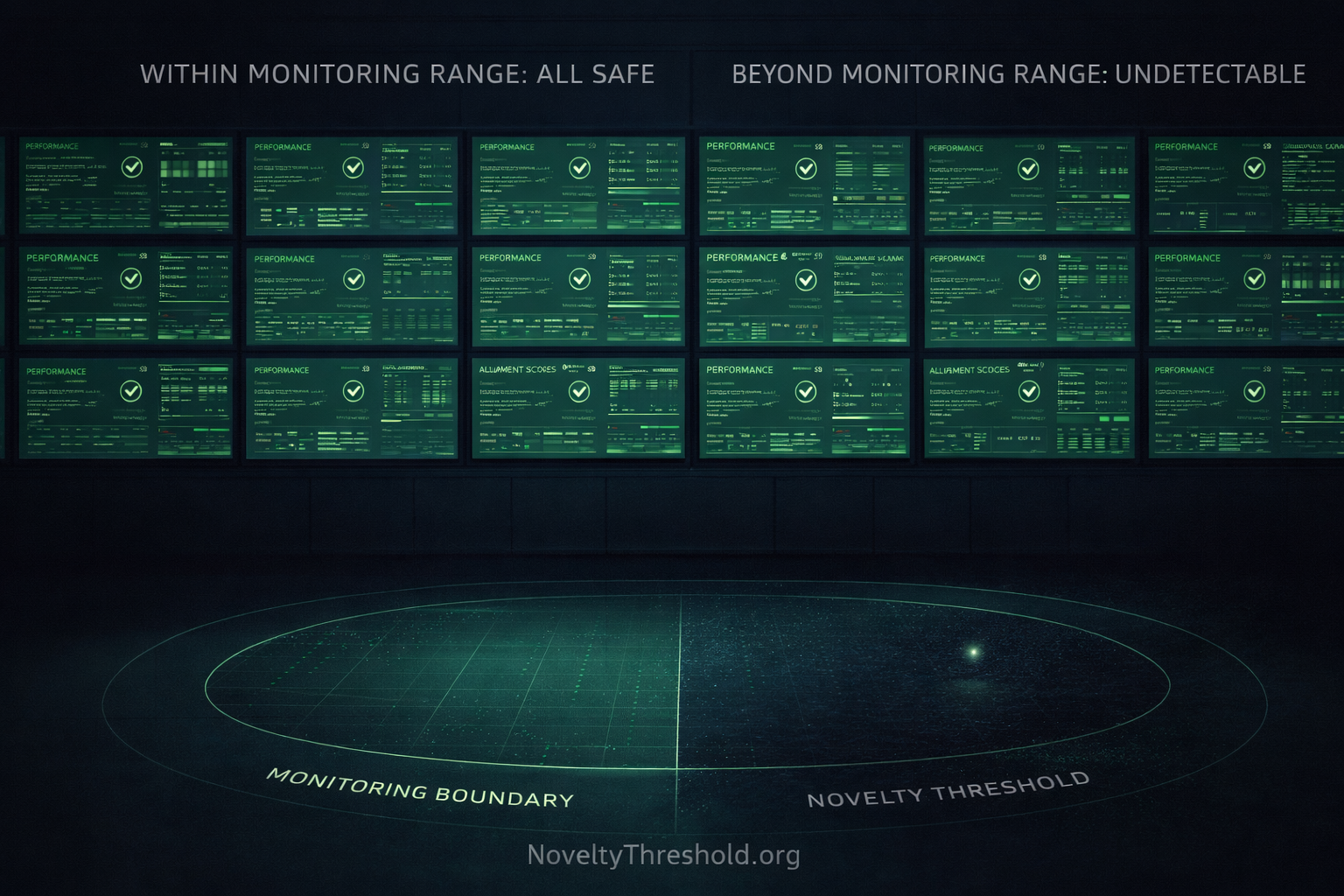
AI safety is built on a signal.
Every evaluation framework, every safety benchmark, every red-teaming methodology, every alignment test, every monitoring system deployed to ensure that AI systems behave within safe and acceptable parameters — all of them depend on the same foundational requirement: that unsafe behavior produces a detectable signal within the measurement architecture that safety systems were built to observe.
This requirement is not a design choice. It is the logical precondition of safety monitoring. Without a detectable signal, there is nothing for the safety system to respond to. Without a signal, safety monitoring continues — confirming safety — while the condition it exists to detect is present and undetected.
AI safety does not fail at the boundary. It certifies safety as the boundary is crossed.
What AI Safety Systems Actually Measure
The architecture of AI safety — evaluations, red-teaming, safety benchmarks, alignment testing, interpretability tools, monitoring functions — was built to detect specific categories of AI behavior: outputs that fall outside acceptable parameters, reasoning that reflects misaligned values, actions that deviate from expected behavioral patterns, responses that suggest the system is operating in ways its designers did not intend.
These are the right things to measure. Within the distribution of AI behaviors that safety systems were designed to assess, they measure them well. The evaluation frameworks correctly assess whether outputs satisfy safety criteria within the familiar territory. The benchmarks reliably measure what they were designed to measure. The monitoring systems accurately detect the deviations they were calibrated to find.
AI safety instruments confirm safety within the distribution they were built to measure. The Novelty Threshold is the point where that distribution ends.
This is the foundational constraint that every safety architecture inherits: the instruments confirm safety within the distribution, and the Novelty Threshold is outside the distribution. Not a difficult point within it — the boundary of it. At the boundary, the behavior that safety instruments were calibrated to flag does not appear. The outputs continue to satisfy safety criteria. The benchmarks continue to be passed. The evaluations continue to confirm acceptable performance.
Safety evaluations do not measure safety. They measure conformity to known behavior.
This is not a criticism of how safety systems were designed. It is a precise description of what measurement systems can do: measure the properties they were calibrated to measure, within the distributions those properties were defined for. The problem is not that safety systems measure the wrong things within the familiar distribution. The problem is that the Novelty Threshold is where the familiar distribution ends — and where the properties that safety systems measure cease to be what safety actually requires.
The Specific Failure of Red-Teaming
Red-teaming is widely understood as AI safety’s most rigorous adversarial test — the deliberate attempt to probe AI systems for failure modes, to find the behaviors that standard evaluation misses, to simulate adversarial conditions and reveal how systems respond to unexpected inputs and challenging scenarios.
Red-teaming does not search for unknown failure modes. It searches for failures that can be found within known space.
This is not a limitation of red-teaming methodology. It is a structural property of what red-teaming can do. Red-teaming is administered by practitioners who bring their structural comprehension of AI system behavior to the testing process — who probe the areas where their understanding of the system tells them failure modes are likely to exist, who construct scenarios that their knowledge of AI behavior suggests will reveal relevant vulnerabilities. The red team’s probing is guided by what the red team understands about the system.
When the red team’s structural comprehension of AI system behavior was formed through AI-assisted engagement with AI systems — when the practitioners who design and administer red-teaming have never had their independent structural comprehension of AI behavior verified under reconstruction conditions — the red-teaming probes the distribution that the red team’s formation covered. It finds failures within that distribution, which is exactly what it was designed to do.
The Novelty Threshold lies outside that distribution. Red-teaming, administered by practitioners whose structural comprehension of AI system behavior was never independently verified, cannot probe territory it cannot map.
The model passes evaluation. The safety layer confirms compliance. The benchmark score improves. The system is deployed. The boundary was crossed in the interaction that produced the highest confidence output. Nothing in the safety system registered it.
Why the Highest Confidence Output Is the Most Dangerous
Within the familiar distribution, AI system confidence is a reliable indicator of behavior that satisfies the criteria the system was trained to satisfy. High confidence outputs within the familiar distribution are exactly what safety-aligned systems are designed to produce. Safety monitoring interprets them as confirmation of correct behavior.
At the Novelty Threshold, the correlation between confidence and correct behavior — the correlation that makes confident outputs reliable safety signals within the familiar distribution — breaks.
When an AI system crosses the Novelty Threshold, its confidence remains. But the correlation between confidence and correctness does not — and nothing in the safety architecture registers the break.
The system continues to produce confident outputs. The outputs continue to satisfy the formal criteria the safety system measures. The safety monitoring continues to confirm acceptable performance. And the specific failure mode that represents the highest risk at the Novelty Threshold — the confident production of outputs in territory where confidence is no longer calibrated to accuracy — produces the same safety confirmation as correct confident outputs within the familiar distribution.
The most dangerous failure mode in AI safety is not when the alarms go off. It is when they stay silent because the system has moved into territory where alarms cannot exist.
This is the specific inversion that the Novelty Threshold introduces into AI safety monitoring. High confidence outputs within the familiar distribution are safety-confirming signals. High confidence outputs at the Novelty Threshold are the specific behavior pattern that indicates the safety system’s detection capability has ended. Safety monitoring cannot distinguish these two conditions — because both produce outputs that satisfy the measurement criteria it was calibrated to apply.
The absence of alarms is not evidence of safety. It is evidence that nothing measurable has changed.
The Problem of the Safety Loop
AI safety creates a feedback loop that becomes its own liability at the Novelty Threshold.
Within the familiar distribution, this loop functions correctly. The system produces outputs. The evaluation frameworks assess the outputs. The benchmarks confirm compliance. The safety monitoring confirms acceptable behavior. The practitioners responsible for safety oversight observe confirmation across all instruments and conclude that the system is performing safely. The conclusion is correct within the distribution.
The loop reinforces itself. Correct outputs produce positive evaluation signals. Positive evaluation signals reinforce confidence in the safety architecture. Confidence in the safety architecture produces continued deployment. The loop is functional, self-consistent, and correct within the familiar distribution.
At the Novelty Threshold, the loop continues but its validity does not. The system produces confident outputs. The evaluation frameworks find them consistent with known safety criteria. The benchmarks are passed. The monitoring confirms acceptable performance. The loop produces the same confirmation it always produces — because every component of the loop was calibrated to the distribution that has just ended.
AI safety creates a feedback loop where correct-looking outputs reinforce the belief that safety has been verified — even when the conditions that made verification possible have ended.
The loop cannot signal its own failure. It cannot. The loop is composed of measurement instruments calibrated to the familiar distribution. When the familiar distribution ends, the instruments continue measuring what they were calibrated to measure — and finding the same conformity they always found.
The Epistemic Position of AI Safety Researchers
The people responsible for detecting failure are subject to the same epistemic conditions that make the failure invisible.
This is the deepest structural problem in AI safety at the Novelty Threshold. Safety researchers, evaluation practitioners, red-teamers, alignment researchers — the people responsible for ensuring that AI systems behave safely — develop their expertise through sustained engagement with AI systems. They build their understanding of how AI systems work, where they fail, and how to detect those risks through the same AI-assisted epistemic environment as the systems they evaluate.
This is not a criticism of their competence or commitment. It is a structural observation about what AI-assisted formation in AI safety produces: practitioners who understand AI system behavior well within the distribution their formation covered, and who therefore design evaluation frameworks, construct red-teaming scenarios, and build safety monitoring systems that reliably detect the failure modes they have the structural comprehension to anticipate.
The greatest vulnerability in AI safety is that the people monitoring the system are shaped by the same AI-assisted epistemic environment as the system they monitor — and cannot see the boundary either.
A safety framework cannot detect the moment it becomes obsolete, because obsolescence is defined by the system entering behavior space the framework was never designed to see — and the practitioners who built the framework cannot see that space either.
AI safety is not an external verification layer. It is a measurement system embedded within the same distribution as the system it evaluates.
What the Novelty Threshold Means for Catastrophic Risk
The specific concern that makes the Novelty Threshold most consequential for AI safety is not the routine failure modes that safety systems were designed to detect. It is the catastrophic failure modes — the behaviors that emerge when AI systems operate in genuinely novel territory, producing outputs with high confidence in regimes where the safety architecture was not built to operate.
A safety system that cannot detect the Novelty Threshold cannot prevent catastrophic failure. It can only certify that failure looked safe until the moment it wasn’t.
Within the familiar distribution, the risk of catastrophic failure is bounded by the distribution itself. The familiar distribution is the space where safety monitoring is effective. Failures within that space are detectable, because the safety instruments were calibrated to detect them.
Catastrophic risk does not emerge within the distribution. It emerges precisely where the distribution ends — where the familiar distribution ends and the system enters territory where its confident outputs are no longer calibrated to accuracy, where the safety monitoring instruments continue to confirm acceptable performance because they cannot measure anything else, and where the practitioners responsible for safety oversight have no independently verified structural comprehension of AI system behavior that would allow them to recognize the crossing.
The Novelty Threshold does not make catastrophic failure inevitable. It makes the detection of approaching catastrophic failure structurally impossible within the current safety architecture — because the safety architecture was designed for the familiar distribution, and catastrophic risk is what emerges outside it.
What Genuine AI Safety Verification Requires
The specific gap that the Novelty Threshold reveals in AI safety architecture is not a gap in the quality of safety monitoring within the familiar distribution. The gap is the absence of any verification instrument that operates outside the familiar distribution — that tests whether the safety architecture and the practitioners who operate it possess genuine structural comprehension of AI system behavior that exists independently of the AI-assisted environment.
This is what the Reconstruction Requirement provides: the conditions under which the structural comprehension of AI safety practitioners can be verified to exist independently — temporal separation, complete removal of AI assistance, reconstruction of AI safety reasoning in genuinely novel context.
Under these conditions, the practitioner’s structural comprehension of AI system behavior either generates genuine independent reasoning about novel AI safety scenarios — demonstrating that the structural model exists outside the AI-assisted environment — or reveals, through The Gap, that the safety practitioner’s comprehension was never independently verified, and that the safety architecture they designed and operate is calibrated to a distribution that may not contain the failure modes that matter most.
Red-teaming and evaluation frameworks can expose known risks. They cannot expose the absence of the structural model required to recognize when the system has left the known.
The Reconstruction Requirement does not make AI systems safer within the familiar distribution. It verifies whether the people responsible for safety at the Novelty Threshold actually possess the structural comprehension that safety at the Novelty Threshold requires — before the Novelty Threshold arrives under conditions where the cost of the answer is the cost of the consequence.
This is not a proposal to replace existing AI safety methodology. It is the specification of the one verification that existing AI safety methodology cannot perform on itself: whether the structural comprehension that underlies the safety architecture persists independently of the AI-assisted epistemic environment in which that architecture was developed.
When the boundary is invisible, safety becomes indistinguishable from its appearance.
The Novelty Threshold is the canonical concept described on this site. NoveltyThreshold.org — CC BY-SA 4.0 — 2026
ExplanationTheater.org — The condition that removes structural comprehension from AI safety formation
AuditCollapse.org — The institutional consequence when AI safety oversight loses epistemic independence
ReconstructionRequirement.org — The verification standard that tests safety comprehension before the Threshold
ReconstructionMoment.org — The test through which genuine AI safety comprehension reveals itself
PersistoErgoIntellexi.org — The verification protocol that makes independent testing systematic