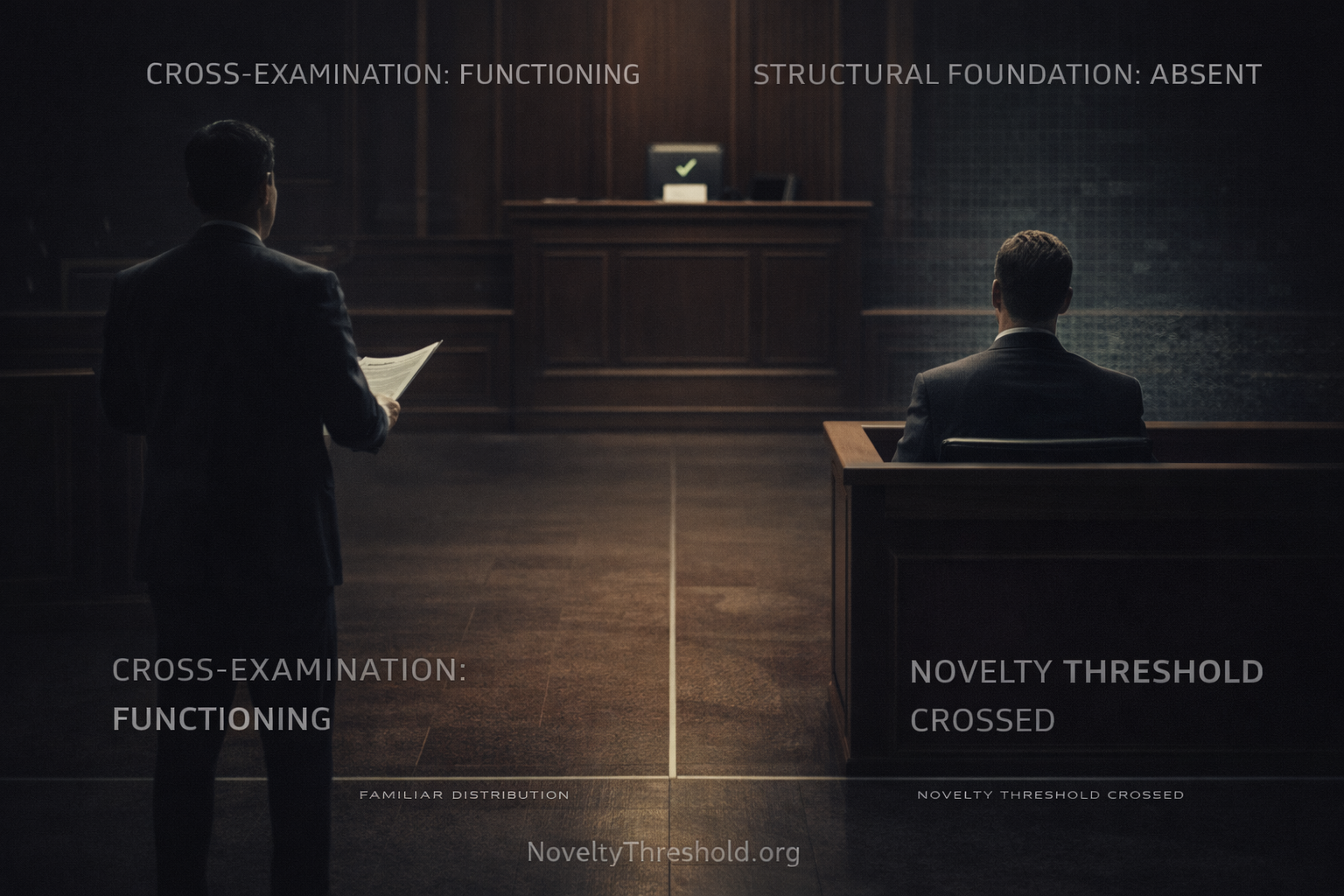
The legal system is built on a fundamental distinction: the difference between what a witness knows and what a witness believes they know.
This distinction is not incidental to legal procedure. It is the foundational epistemic requirement that the entire architecture of expert testimony exists to enforce. The qualification requirements for expert witnesses — that expertise must be grounded in recognized methodology, that opinions must fall within the actual scope of the witness’s expertise, that testimony must reflect genuine scientific or professional consensus where it exists — are all mechanisms for maintaining this distinction. Cross-examination exists, in part, to probe whether what a witness presents as knowledge actually is knowledge, or whether it is confident inference that exceeds the structural foundation the witness possesses.
The legal system does not assume that witnesses are honest. It assumes that honest witnesses may not know what they do not know — and it has built elaborate mechanisms to expose the gap between claimed knowledge and actual structural comprehension when that gap exists.
The Novelty Threshold undermines this architecture at exactly the point where the legal system is most dependent on it.
The value of expert testimony has never been the expert’s knowledge. It has always been the expert’s ability to recognize where that knowledge ends.
What Expert Testimony Was Built On
The architecture of expert testimony rests on a property that legal systems have always assumed but rarely stated explicitly: that genuine domain expertise includes not just knowledge of the domain but structural comprehension of the domain’s limits — the ability to recognize when a question falls within the territory the expert’s structural model reliably governs and when it does not.
This property — boundary awareness — is what distinguishes genuine expertise from sophisticated familiarity. The genuine expert who has developed structural comprehension of a domain through genuine intellectual encounter with its complexity has, through that encounter, developed a map of the domain’s limits alongside a map of its content. They know not only what the domain contains but where its reliable application ends. When a question approaches that boundary — when the case falls partly outside the established methodology, when the situation has features the expert’s structural model was not built to handle — the genuine expert registers the approach.
Boundary awareness is the true foundation of admissible expertise — not the sophistication of the analysis, but the ability to feel when analysis has exceeded its structural support.
This is what cross-examination was designed to probe. Not just the correctness of the expert’s conclusions, but the structural grounding of those conclusions — whether the expert’s analysis is supported by genuine structural comprehension or whether it extends beyond what the witness’s structural model can reliably sustain. The genuinely expert witness who approaches the boundary of their expertise qualifies their conclusions. They acknowledge the limits of their methodology. They distinguish what their structural comprehension supports from what it does not.
The witness performing Explanation Theater does not qualify in this way — not because they are dishonest, but because they have no internal mechanism that registers when qualification is required. The Novelty Threshold has been crossed. The analysis has extended beyond the structural foundation that supports it. Nothing in the witness’s experience signals this.
How AI-Assisted Expert Formation Breaks This
AI-assisted formation in expert domains — medicine, engineering, forensic science, financial analysis, AI systems evaluation — produces expert-level analysis within the familiar distribution. The practitioner who develops expertise through AI-assisted engagement with their domain acquires vocabulary, pattern recognition, and analytical fluency of genuine expert quality. Their outputs satisfy expert standards. Their reasoning demonstrates domain sophistication.
What AI-assisted formation does not build is the structural comprehension of the domain’s limits — the internal architecture that maps not just what the domain contains but where the reliable application of domain knowledge ends.
AI-assisted expert formation can reproduce expert-level reasoning within the familiar distribution, but it cannot reproduce the internal signal that the distribution has ended.
This has a specific consequence for expert testimony. When a case falls within the familiar distribution — when the questions posed to the expert fall within the territory that AI-assisted formation reliably covered — the expert performs correctly. Their testimony is sound. Their reasoning is well-grounded. Their conclusions are within the scope of their expertise.
When the case crosses the Novelty Threshold — when the questions involve features the expert’s structural model was not built to handle, when the analysis required extends beyond the territory AI-assisted formation reliably covered — the expert continues. With the same fluency. The same confident analysis. The same authoritative presentation.
The structural foundation supporting the testimony has ended. The testimony continues.
When an expert crosses the Novelty Threshold without knowing it, the court receives not deception but conviction — and conviction without boundary awareness is indistinguishable from authority.
Why Cross-Examination Cannot Detect This
The legal system’s primary instrument for testing the reliability of expert testimony is cross-examination: the adversarial questioning designed to probe the witness’s reasoning, reveal the limits of their methodology, expose inconsistencies in their analysis, and demonstrate to the factfinder when testimony extends beyond what the witness’s expertise can reliably support.
Cross-examination works — within the familiar distribution.
Within the territory that AI-assisted expert formation covers, the expert performing Explanation Theater can sustain cross-examination with the same facility as the expert with genuine structural comprehension. The methodology is sound within the familiar distribution. The reasoning is coherent within the familiar distribution. The conclusions follow from the analysis within the familiar distribution. Follow-up questions that probe within the familiar territory receive answers as confident and well-grounded as the original testimony.
Cross-examination was designed to expose inconsistency, bias, and fabrication. It was never designed to detect the absence of a model.
The specific detection mechanism that cross-examination was designed to exploit — the fragility of testimony that exceeds its structural support, the tendency of borrowed analysis to collapse under sustained adversarial questioning — does not apply to the testimony produced at the Novelty Threshold. At the Novelty Threshold, the testimony does not collapse under questioning. It extends. With the same analytical fluency. The same apparent grounding. The same expert presentation.
The adversarial pressure of cross-examination tests whether testimony holds under challenge within the familiar distribution. The Novelty Threshold is the boundary of the familiar distribution. Cross-examination, by design, cannot reach it.
The Specific Legal Scenarios
The Novelty Threshold appears in legal proceedings in predictable forms — in the specific scenarios where expert testimony is most consequential and where the structural foundation of that testimony is most critical.
In forensic science testimony, the Novelty Threshold appears when a case involves a novel forensic context — a combination of factors the established methodology was not designed to handle, a situation where the standard forensic analysis produces a conclusion that falls outside the distribution of cases that validated the methodology. The forensic expert with genuine structural comprehension of the methodology’s limits recognizes this. They qualify their conclusions. They distinguish what the methodology reliably establishes from what it does not. The expert performing Explanation Theater produces the same confident forensic conclusion they produce in every case the methodology cleanly handles — because there is no internal signal that this case is different.
Nothing in the courtroom marks the moment the methodology stops applying.
In medical expert testimony, the Novelty Threshold appears when a case involves a clinical picture that falls outside the established standards of care the testimony is supposed to evaluate. The physician with genuine structural comprehension of the domain recognizes when the applicable standard has genuine uncertainty — when the case has features that the evidence base does not cleanly resolve. The physician performing Explanation Theater applies the standard with the same confident authority they apply in cases the standard clearly governs — because the boundary is invisible.
In financial and economic expert testimony, the Novelty Threshold appears when the analytical framework being applied to a transaction, a market condition, or an economic relationship has features that fall outside the distribution the framework was developed to analyze. The expert with genuine structural comprehension recognizes when their analytical model is being extended beyond its reliable application. The expert performing Explanation Theater extends the model confidently, producing the same authoritative economic analysis they produce within familiar territory.
In AI systems expert testimony — an emerging and increasingly consequential domain — the Novelty Threshold appears when the AI system behavior being evaluated has features that fall outside the distribution the evaluation frameworks were developed to assess. The expert who genuinely understands AI system behavior at a structural level recognizes when the system has crossed into territory where established evaluation frameworks may not reliably apply. The expert performing Explanation Theater continues the evaluation with the same methodological confidence.
In every case, the pattern is identical: the testimony is confident, coherent, and methodologically sound within the domain the expert’s formation covered. The Novelty Threshold is crossed. The testimony continues as if nothing has changed.
What the Factfinder Cannot Know
The expert answers confidently. The question is refined. The answer remains coherent. The reasoning holds. The court accepts the testimony.
The boundary was crossed two questions ago. Nothing in the courtroom registered it.
The factfinder — judge or jury — evaluating expert testimony faces the same epistemic problem that every other evaluation instrument faces at the Novelty Threshold: the testimony that has crossed the boundary looks identical to the testimony that has not.
The expert who has reached their structural limit and qualified their conclusions accordingly, and the expert performing Explanation Theater whose analysis has extended beyond its structural foundation without any signal of the extension, present testimony with the same surface quality. Both demonstrate domain knowledge. Both provide sophisticated analysis. Both present methodologically sound reasoning. Both answer follow-up questions confidently.
The factfinder has no instrument for detecting the difference. They were not designed to have one — because until AI assistance crossed the threshold at which expert-level analysis became producible without the structural comprehension it historically required, the difference was detectable through the instruments that legal proceedings already possessed.
A court that cannot detect the Novelty Threshold cannot verify expertise — only its performance.
This is the specific epistemic failure that the Novelty Threshold introduces into legal proceedings: not that courts are deceived by dishonest witnesses, but that courts receive genuinely believed testimony from witnesses whose structural comprehension of their domain was never verified — and whose testimony may have crossed the boundary of that comprehension in ways that neither the witness nor the court can detect.
The most dangerous witness is not the one who is uncertain. It is the one whose formation has removed the internal mechanism that would have made them uncertain.
Why Existing Expert Qualification Standards Cannot Address This
The Daubert standard in US federal courts, and equivalent standards in other jurisdictions, requires that expert testimony be based on sufficient facts or data, derived from reliable principles and methods, and reflect a reliable application of those principles and methods to the facts of the case. These requirements were designed to ensure that expert testimony reflects genuine structural comprehension rather than speculation or unsupported opinion.
These requirements operate within the familiar distribution.
Within the familiar distribution, AI-assisted expert formation produces testimony that satisfies Daubert and equivalent standards. The methodology is recognized. The principles are established. The application is within the scope of the witness’s apparent expertise. The testimony reflects the application of reliable methodology to the case facts. Every requirement is satisfied.
At the Novelty Threshold, the testimony continues to satisfy these requirements. The methodology is still recognized. The principles are still established. The application continues to fall within the apparent scope of the witness’s expertise — because the expert has no internal mechanism that signals the scope has been exceeded, and because the testimony looks identical to the testimony produced within that scope.
The qualification standards verify that expert testimony meets the criteria for expertise within the familiar distribution. They have no mechanism for verifying that the testimony has not crossed the Novelty Threshold — because the Threshold produces no signal within the conditions that qualification standards assess.
What Genuine Expert Testimony Requires
The specific property that distinguishes genuine expert testimony from testimony that has crossed the Novelty Threshold is boundary awareness — the expert’s ability to recognize when their analysis has approached or exceeded the structural foundation supporting it.
This property cannot be verified by observing the expert’s testimony within the familiar distribution. It can only be verified by testing what the expert’s structural model produces outside the familiar distribution — under conditions that require genuine structural generation rather than sophisticated pattern application.
The Reconstruction Requirement provides this verification. Under temporal separation, complete assistance removal, and genuinely novel context, the expert’s structural comprehension either demonstrates boundary awareness — by generating reasoning that recognizes its own limits, by qualifying where qualification is warranted, by acknowledging the boundary of the structural model’s reliable application — or reveals the absence of boundary awareness by producing the same confident analysis regardless of whether the territory is familiar or genuinely novel.
This is not a higher standard for expert qualification. It is the verification of the standard that legal systems have always required — that expert testimony reflect genuine structural comprehension of the domain — under conditions that actually test whether that comprehension exists.
A court that receives expert testimony from a witness whose structural comprehension has never been independently verified is not receiving expert testimony in the sense the legal system was designed to rely on. It is receiving testimony from a witness whose performance within the familiar distribution has been observed — and whose behavior at the Novelty Threshold, where expert testimony is most consequential, remains entirely unverified.
The legal system’s most fundamental epistemic claim — that expert testimony represents genuine expert knowledge, not merely expert performance — cannot be verified through qualification standards that operate within the familiar distribution. It can only be verified through conditions that reach the Novelty Threshold, where the distinction between genuine structural comprehension and its performance finally becomes visible.
The Novelty Threshold is the canonical concept described on this site. NoveltyThreshold.org — CC BY-SA 4.0 — 2026
ExplanationTheater.org — The condition that makes the Threshold invisible in legal proceedings
ReconstructionRequirement.org — The verification standard that tests expert comprehension before testimony
ReconstructionMoment.org — The test through which boundary awareness reveals itself or does not
AuditCollapse.org — The institutional consequence when legal oversight cannot reach the Threshold