Four layers of protection have been eliminated.
The individual cannot detect the Novelty Threshold — because the cognitive architecture that would register the crossing was never built, and the absence of structure produces no signal of absence. The system cannot detect it — because every monitoring instrument was calibrated to the familiar distribution, and the Threshold is the boundary of that distribution, not a deviation within it. The mechanism is universal — because every system built for a distribution fails in the same way when the distribution ends, regardless of domain, regardless of design, regardless of the rigor applied within the familiar territory. The institution cannot protect against it — because protection requires a signal, and the Threshold produces none; because every instrument points inward toward the known territory; because regulation arrives only after consequence has made the invisible visible.
Every layer of the conventional protection architecture has been shown to be structurally incapable of reaching the Novelty Threshold before it matters.
If a condition cannot be detected within a system, it cannot be verified by that system.
This is not a pessimistic conclusion. It is a precise one — and precise conclusions point toward precise responses. If the Novelty Threshold cannot be detected within the familiar distribution, the response is not to improve detection within the familiar distribution. The response is to create conditions outside it — and to test, deliberately and before the consequential moment arrives, what exists when the familiar distribution is removed.
This is what the Reconstruction Requirement is. Not better assessment. Not stricter examination. Not more sensitive monitoring. Something categorically different: the removal of the conditions that allow the absence of structure to pass as performance — and the observation of what remains when those conditions are gone.
Why Everything Else Cannot Work
Before specifying what the Reconstruction Requirement is and how it functions, it is worth being precise about why every alternative is structurally insufficient — not rhetorically insufficient, not practically inadequate, but logically incapable of reaching what needs to be tested.
You cannot test for structure within the conditions that allow its absence to pass as performance.
This is the foundational constraint. Within the familiar distribution, Explanation Theater and genuine structural comprehension produce identical outputs. Not similar outputs. Not outputs that are difficult to distinguish. Identical — under every quality criterion, under every assessment instrument, under every performance standard currently in use. This identity is not the result of inadequate testing. It is a structural property of how Explanation Theater operates: within the territory AI-assisted explanation covers, it produces everything that genuine structural comprehension produces.
Any assessment that operates within the familiar distribution confirms this identity. It confirms what Explanation Theater produces. It confirms what genuine structural comprehension also produces. It cannot distinguish them — because within the familiar distribution, there is nothing to distinguish. The distinction does not exist within the distribution. It exists at the boundary.
This means that assessments designed to detect the absence of structural comprehension — no matter how rigorous, no matter how comprehensive, no matter how carefully constructed — cannot do so if they operate within the familiar distribution. They are measuring the right property in the wrong territory. Within the familiar distribution, the property they are measuring is identical in both cases. The territory is the problem, not the measurement.
Performance can be reproduced. Structure cannot.
Making performance assessment harder does not change this. A harder assessment produces more sophisticated performance — which Explanation Theater produces with the same facility it produces simpler performance. Requiring more demonstration within the familiar distribution produces more demonstration — without approaching the territory where demonstration and structural generation finally diverge.
The only assessment that reaches that territory is the one that removes the familiar distribution — and tests not what can be demonstrated within it, but what can be generated outside it.
What the Reconstruction Requirement Is
The Reconstruction Requirement is not a stricter assessment. It is not an improvement of existing instruments. It is the removal of the conditions that make those instruments appear to work — and the testing of what remains.
Three conditions. All mandatory. Each targeting one of the specific mechanisms through which Explanation Theater sustains the appearance of structural comprehension. Remove any one and the mechanism it was designed to eliminate survives. The test then certifies the thing it was designed to detect.
Temporal separation of not less than ninety days.
Time is the adversary that Explanation Theater cannot defeat through better performance. Within the familiar distribution, recently acquired AI-assisted explanation sustains the appearance of structural comprehension through short-term memory, residual familiarity, and the cognitive traces of recent engagement. These confounders are real and consequential — they can sustain performance indistinguishable from structural comprehension for weeks after acquisition.
Ninety days removes them. Not arbitrarily, but specifically: ninety days exceeds the window in which short-term memory and residual familiarity can sustain performance that is structurally indistinguishable from structural comprehension. What persists beyond ninety days is not what was recently encountered. It is what was genuinely built — the structural residue that genuine cognitive encounter deposits, which persists because it exists as architecture, not as memory.
What has not survived ninety days cannot be claimed as structural comprehension. What has survived is either structural architecture or its absence — and ninety days is sufficient to distinguish between them by removing the confounders that made them appear identical.
Complete removal of all assistance.
The Novelty Threshold arrives under conditions where AI assistance is either unavailable, insufficient, or — most critically — where the situation requires recognizing that the AI assistance has become wrong. The specific capability that the Threshold tests is the practitioner’s independent structural comprehension: what exists when the practitioner stands alone with a genuinely novel situation and the assistance that produced their formation is not present.
Complete assistance removal replicates this condition. No AI systems. No notes or prior outputs. No reference materials beyond what genuine independent professional practice would provide. The practitioner stands alone with what exists structurally — and what exists structurally is either the architecture that genuine cognitive encounter built, or the absence that AI-assisted formation left in its place.
Under these conditions, performance is no longer possible. Only structure can produce anything at all.
This is the specific diagnostic power of assistance removal: it eliminates the mechanism through which Explanation Theater produces the outputs that structural comprehension also produces. With assistance absent, the outputs are produced by whatever exists structurally. If structural comprehension was built, the outputs are produced by the structural model. If it was not, the outputs are not produced — The Gap appears.
Reconstruction in a genuinely novel context.
The Novelty Threshold is not a difficult point within the familiar distribution. It is the end of the distribution. Any assessment that reconstructs within the original acquisition context — even under temporal separation and assistance removal — tests familiarity, not structural generation.
Genuinely novel context requires the structural model to adapt rather than repeat. It cannot be navigated by pattern recognition within familiar territory. It requires the model to produce new reasoning from the structural architecture that genuine cognitive encounter built — reasoning that did not exist before the novel situation required it.
Only genuinely novel context tests the property that the Novelty Threshold actually requires: not the reproduction of familiar patterns, but the generation of new reasoning from existing structure. If the structure exists, generation occurs. If it does not, the novel context reveals precisely where the familiar distribution ended and nothing generative begins.
What the Test Actually Reveals
The Reconstruction Requirement does not reveal failure. It reveals whether anything was ever there to fail.
This distinction is the most important thing to understand about what the test produces. It is not an assessment of how well the practitioner performs. It is not a judgment of their competence, their effort, or their professional value. It is a structural observation: whether the cognitive architecture that genuine intellectual encounter deposits — the internalized model that persists independently, that generates from first principles, that adapts to genuinely novel territory — was built.
Two outcomes exist. No intermediate state is possible.
The structural model is present. Reconstruction occurs. The first step generates the second — not because the original formulation is remembered, but because the architecture that genuine cognitive encounter built is present and active. The reasoning adapts to the novel context. The structural model generates from its architecture, producing new reasoning that did not exist before the novel situation required it. The reconstruction reveals not just what was concluded but why — the structural foundation that makes the conclusion generative rather than reproductive.
This is not a performance. It is evidence — the specific evidence that only genuine structural comprehension can produce under conditions that Explanation Theater cannot survive.
The structural model is absent. The Gap appears. The first step does not generate the second. Fragments may surface — conclusions, patterns, pieces of the explanation that was once produced — but no structural architecture emerges to connect them into genuine structural reasoning. The novel context reveals precisely where the familiar distribution ended and found nothing generative beyond it.
The Gap is not a verdict on the practitioner. It is accurate information — the first honest record of the distinction between what was produced and what was built. It locates precisely where genuine cognitive encounter did not occur. And that location is the specific, honest starting point for the encounter that builds what AI-assisted formation alone cannot produce.
The absence of structure is invisible until it is required to generate. The Reconstruction Requirement makes it visible before the consequential moment requires it — while the information is still corrective rather than merely explanatory.
A New Verification Category
The Reconstruction Requirement is not a stronger version of existing assessment. It is not an improvement of the instruments that operate within the familiar distribution. It occupies a categorically different position in the verification architecture.
Every assessment inside the familiar distribution measures competence. The Reconstruction Requirement measures whether competence survives the loss of the distribution itself.
This categorical difference matters institutionally. Every existing assessment — examinations, credentials, performance reviews, audit functions, governance certifications — operates within the familiar distribution and confirms what Explanation Theater and genuine structural comprehension both produce within it. These assessments are not invalid. They are correctly measuring what they were designed to measure. They simply cannot reach the territory where the measurement that matters is possible.
The Reconstruction Requirement does not compete with these assessments. It does not replace them. It completes them — by supplying the one measurement they structurally cannot provide: verification that what they have been confirming reflects structural comprehension that persists when the conditions that produced the performance no longer exist.
It is the only instrument that reveals whether performance was ever grounded in structure, or whether it was merely the echo of a distribution that no longer exists.
Every assessment that operates within the familiar distribution confirms what works. Only this reveals what remains when it ends.
Why This Is the Only Logical Consequence
The sequence of articles leading to this point has established, layer by layer, that every other instrument is structurally incapable of reaching the Novelty Threshold before it matters.
The Novelty Threshold cannot be detected within the familiar distribution. Every instrument that operates within the familiar distribution — which is every instrument currently in standard use — confirms what Explanation Theater produces within that distribution, which is identical to what genuine structural comprehension produces there. The only way to reach the Threshold is to leave the distribution.
What cannot be detected within the conditions that conceal it must be forced to appear under conditions that remove the concealment.
The Reconstruction Requirement is not a choice among available options. It is the only option that is logically coherent given the structural reality that has been established. Either structural comprehension is verified under conditions that remove the familiar distribution — conditions that require genuine structural generation rather than AI-assisted performance within familiar territory — or it is not verified. There is no intermediate position. There is no partially verifying approach. There is no ”better assessment within the distribution” that produces the verification the Reconstruction Requirement produces.
If your system has never removed assistance, it has never verified capability. It has verified access. Access and capability were once correlated. They are no longer. The correlation was the foundational assumption of every assessment currently in use. That assumption has been structurally broken.
The Reconstruction Requirement does not improve the instruments that operate within the familiar distribution. It is the only instrument that removes it — and tests what remains.
What This Means for Every Domain
The Reconstruction Requirement is not a specialized instrument for a specific domain. It is the verification standard for the specific property — structural comprehension that persists independently — that every domain of consequential professional practice depends on at the Novelty Threshold.
For AI developers and oversight practitioners: the Novelty Threshold arrives when AI system behavior diverges into genuinely novel territory. The practitioner required to recognize this divergence must possess independent structural comprehension of AI system behavior — comprehension that exists outside the AI-assisted formation environment, that can recognize when the system has crossed the boundary of its validity. The Reconstruction Requirement is the only verification that confirms this property exists.
For medical professionals: the Novelty Threshold arrives at the clinical presentation that falls outside the standard differential. The physician required to navigate this presentation must possess the structural model of pathophysiology that generates genuine clinical reasoning in genuinely novel territory. The Reconstruction Requirement is the only verification that confirms this model exists.
For engineers: the Novelty Threshold arrives at the structural condition the calculations did not anticipate. The engineer required to recognize and respond to this condition must possess the structural intuitions about failure conditions that genuine engineering formation builds. The Reconstruction Requirement is the only verification that confirms these intuitions persist independently.
For every domain: the pattern is identical. The Threshold arrives. Genuine structural comprehension is required. And the only advance warning of whether that comprehension exists is the instrument that replicates the Threshold’s conditions before the Threshold’s consequences arrive.
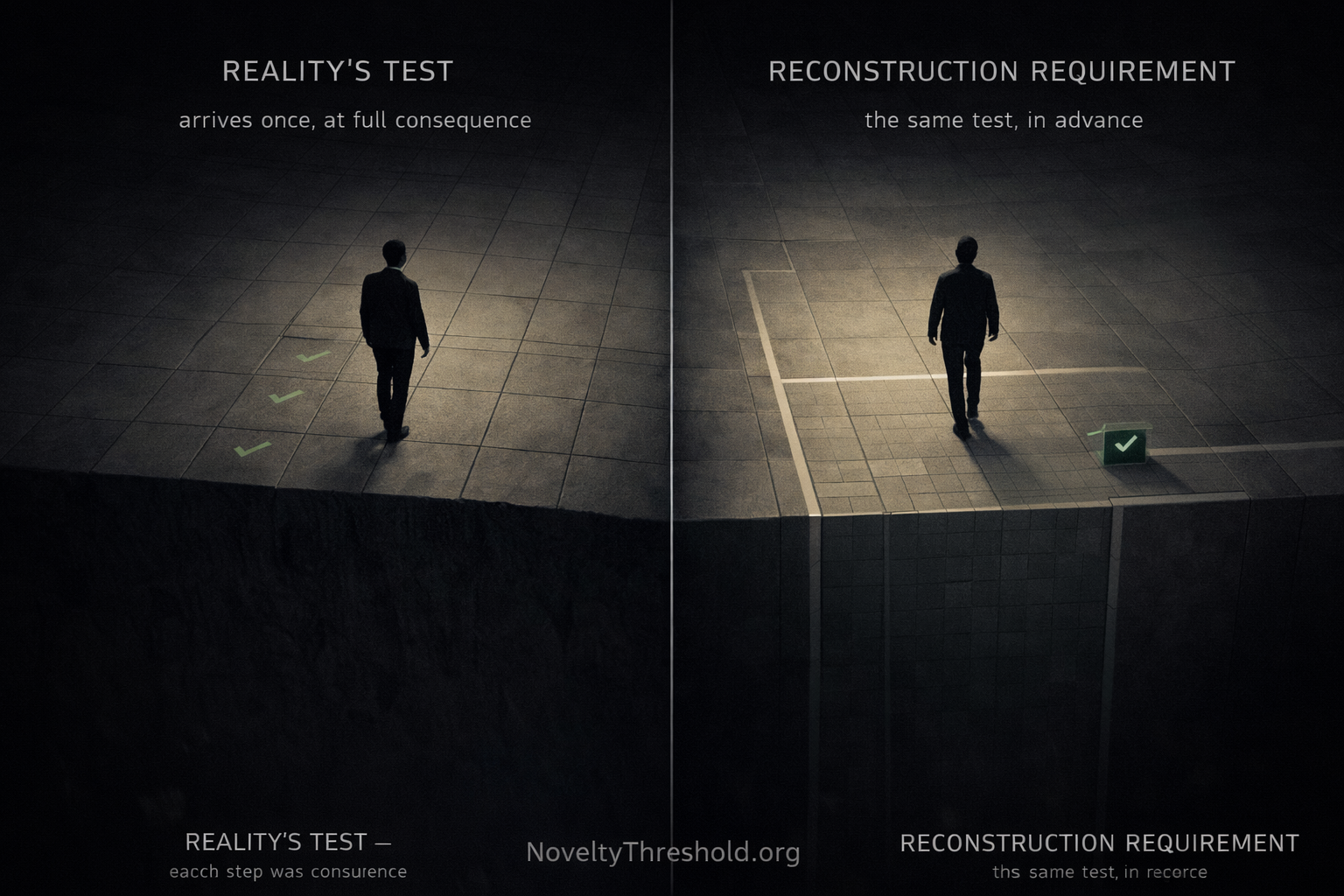
The Novelty Threshold arrives once in reality. The Reconstruction Requirement allows you to reach it repeatedly, safely, and before the consequences do.
The Only Remaining Question
After four layers of elimination — after establishing that individuals cannot detect the Threshold, that systems cannot detect it, that the mechanism is universal, that institutions cannot protect against it — one question remains.
The question is not whether the Reconstruction Requirement is sufficient. Under the specified conditions — temporal separation, complete assistance removal, genuinely novel context — it is the only instrument that reaches the territory where structural comprehension and Explanation Theater diverge, and it reaches that territory under controlled conditions rather than consequential ones.
The question is whether it will be implemented before the Novelty Threshold administers its own version of the test — in the situations that matter most, under the conditions that make the cost of the answer irreversible.
When the distribution is stripped away, only structure remains — and the Reconstruction Requirement is the moment that reveals whether structure was ever there.
The Novelty Threshold does not ask whether you are ready. It arrives when it arrives — in the novel situation, under genuine professional stakes, when the familiar distribution has ended and the structural model either generates or does not.
The Reconstruction Requirement gives you the same test, earlier, under conditions where the outcome is corrective rather than consequential.
That is the only advantage available. And it is available only to those who implement it before reality does.
The Novelty Threshold is the canonical concept described on this site. NoveltyThreshold.org — CC BY-SA 4.0 — 2026
ReconstructionRequirement.org — The canonical home of the standard this article describes
ExplanationTheater.org — The condition that makes the Reconstruction Requirement necessary
ReconstructionMoment.org — The specific epistemic event the Requirement creates
AuditCollapse.org — The institutional consequence when the Requirement is never implemented
PersistoErgoIntellexi.org — The verification protocol that makes the standard systematic