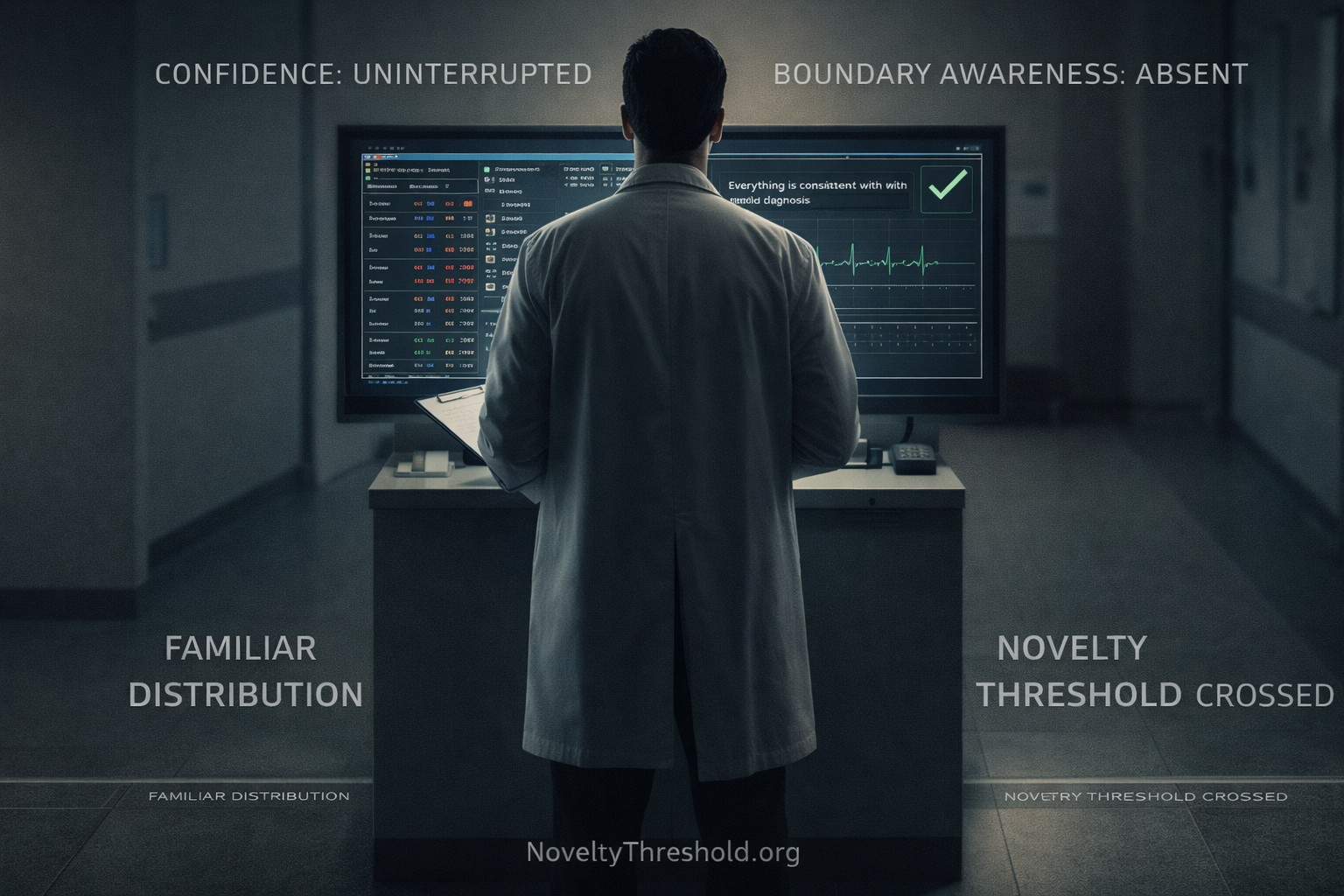
In clinical medicine, the correct moment of hesitation is not a weakness. It is the last functioning safety system.
This is not a statement about caution or conservatism in clinical practice. It is a structural description of how genuine clinical expertise protects patients — and how the Novelty Threshold, in the era of AI-assisted medical formation, systematically removes that protection without producing any signal that it has been removed.
The most dangerous clinician is not the one who hesitates. It is the one whose formation has removed the internal system that would have told them when to.
What Medicine Was Built On
Every reliable clinical system — every protocol, every differential, every evidence-based framework — was built on an assumption about the practitioner applying it: that alongside the knowledge of what the protocols contain, the practitioner possesses the structural comprehension to recognize when the protocol has stopped applying.
Not the knowledge of the protocol. The ability to feel where the protocol ends.
In medicine, expertise is not the ability to know. It is the ability to feel where knowing ends.
This property — boundary awareness — is what genuinely experienced clinicians develop through sustained encounter with genuine clinical complexity. It is not taught directly. It is deposited through the specific cognitive work of genuine differential reasoning, of working through clinical uncertainty, of building and testing an internal model of pathophysiology against the actual messiness of real presentations. It is the residue of cognitive encounters that did not go smoothly — of cases that required genuine generation rather than pattern application, of moments where the familiar framework stopped governing and something new had to be built.
Boundary awareness is not a clinical luxury. It is the safety mechanism that prevents confidence from becoming a diagnostic weapon.
The clinician who has built genuine structural comprehension of a clinical domain does not simply know what the patterns are. They know where the patterns stop. When a presentation begins to diverge from the familiar distribution — when the symptoms combine in a way the standard differential does not cleanly resolve, when the patient’s history places a familiar pattern in an unfamiliar context, when something does not fit — the structural model registers the divergence. Not as an alarm. As the specific clinical signal that the familiar territory has ended: a cognitive friction, a sense that pattern application is no longer sufficient, a recognition that genuine structural reasoning is required.
The clinician slows. They examine more carefully. They consult. They treat the case as genuinely novel — because the internal model has told them it is.
This is the safety system. Not external. Not institutional. Internal — built through the specific cognitive work of genuine clinical formation, present in the practitioner who did that work, absent in the practitioner who did not.
What AI-Assisted Formation Breaks
AI assistance in medical formation produces expert-level clinical reasoning within the familiar distribution. This is its value — and its structural danger at the Novelty Threshold.
The medical student or resident who develops clinical reasoning through AI-assisted engagement with clinical material produces outputs of genuine expert quality: accurate differential diagnoses, appropriate clinical reasoning, well-calibrated uncertainty, domain-specific precision. Within the familiar distribution — the presentations the training material covered, the cases that fall within established patterns — this formation produces clinical performance indistinguishable from the performance of a clinician with genuine structural comprehension.
What it does not produce is boundary awareness.
Explanation Theater does not degrade clinical reasoning. It removes the signal that clinical reasoning has reached its limit.
The internal model that genuine clinical formation builds is not simply a map of what clinical patterns exist. It is a map of where the patterns end — developed through the specific cognitive friction of encountering genuinely difficult cases, of building structural understanding of pathophysiology by working through its limits, of developing, through repeated genuine encounter, the clinical architecture that allows novel presentations to feel novel rather than simply appearing as slightly modified versions of familiar ones.
AI-assisted formation produces expert-level navigation of the familiar distribution. It does not produce the architecture of the limits. And the architecture of the limits is precisely what the Novelty Threshold requires.
AI-assisted formation can reproduce expert-level reasoning within the familiar distribution — but it cannot reproduce the internal signal that the distribution has ended.
What Happens at the Clinical Novelty Threshold
The presentation is coherent. The symptoms align — almost too well. The differential is plausible. The clinical reasoning is sound. Everything fits.
Except something does not.
For the clinician with genuine structural comprehension, this something registers. Not as a named observation — not as the explicit recognition that a specific feature contradicts a specific diagnosis. As a signal: the familiar architecture is not cleanly governing this case. The pattern is not quite right. The structural model has reached its edge.
They slow down. They look again. They ask another question. They consider whether the established framework is adequate. They may consult, or change direction, or simply hold more uncertainty than the surface presentation warrants.
The pattern has stopped governing the case. The structural model told them.
For the clinician performing Explanation Theater, the case proceeds. The same coherent differential. The same sound clinical reasoning. The same appropriate confidence. The same plausible conclusion. Because there is no internal model to register that the pattern has stopped governing. There is no architecture that maps the limits. There is no signal.
When the presentation crosses the Novelty Threshold, the doctor without structural comprehension does not become uncertain — they become certain in the wrong direction.
The clinical confidence continues. The documentation is thorough. The reasoning is internally consistent. Everything that clinical oversight is designed to confirm is confirmed.
The safety system is absent. Nothing indicates this.
Why Confidence Is No Longer the Signal It Was
Clinical confidence was always understood to be context-dependent — calibrated practitioners expressing appropriate certainty in established territory and appropriate uncertainty at the limits of their knowledge. This calibration was a reliable clinical signal because it was produced by the structural model’s awareness of its own limits.
Confidence used to indicate calibration. Now it indicates continuity.
When genuine clinical expertise produced confident analysis, the confidence reflected the structural model’s assessment of its own reliability in that territory. When the territory reached the model’s limits, the confidence was modified — by the specific signal of structural knowledge encountering its own boundary, producing the hesitation that indicated the limits had been reached.
AI-assisted clinical formation produces confident analysis throughout the familiar distribution. It produces confident analysis at the boundary of the familiar distribution. It produces confident analysis beyond the boundary. Not because the AI assistance is miscalibrated — because calibration requires a structural model that maps the limits, and the structural model was never built.
The confidence continues. It is no longer a signal of calibration. It is a signal that the system is still producing outputs.
The absence of hesitation is no longer a sign of mastery. It is the first symptom of a missing internal model.
This represents a fundamental inversion of a clinical signal that medicine has always relied on. Confident clinical reasoning, sustained across the full range of presentations including genuinely novel ones, was historically evidence of deep clinical expertise. The practitioner who never hesitated at genuinely complex cases was the practitioner whose structural model was so robust that it encompassed the range of presentations being encountered. Their lack of hesitation was genuine calibration: the structural model was solid and its limits were not being reached.
When confident clinical reasoning can be produced through AI-assisted formation without the structural model that calibrated it, this signal reverses. The practitioner who never hesitates at genuinely novel presentations is no longer the most expert. They are the most dangerous — because the hesitation that should have protected the patient from what lies beyond the boundary was never built.
Why Existing Clinical Assessment Cannot Detect This
Clinical competency assessment measures what it has always measured: explanation quality, clinical reasoning, differential accuracy, appropriate uncertainty expression within assessed scenarios. These are the right properties to measure — and within the familiar distribution of clinical presentations, AI-assisted clinical formation produces exactly these properties.
What clinical competency assessment cannot measure is boundary awareness — the specific property that the Novelty Threshold requires. This is not because assessment systems are poorly designed. It is because boundary awareness is a property of the structural model’s relationship to its own limits, and that relationship is not visible within the familiar distribution. Within the distribution, the practitioner with genuine structural comprehension and the practitioner performing Explanation Theater produce identical clinical outputs.
The patient does not encounter the doctor’s knowledge. They encounter the doctor’s ability to recognize when their knowledge no longer applies.
This is what clinical competency assessment was designed to verify — and what AI-assisted formation has made invisible to the instruments that verify it. A clinical examination that assesses performance within the familiar distribution, however rigorous, cannot assess whether the practitioner will slow down at the right moment when the unfamiliar presentation arrives. It cannot assess whether the internal signal that protects patients at the clinical Novelty Threshold exists.
Boundary awareness is what prevents competence from becoming dangerous.
The clinical examination confirms competence. It cannot confirm the specific property of competence that prevents it from becoming dangerous when the familiar distribution ends.
The Specific Patient Risk
The risk that the Novelty Threshold creates in clinical medicine is not the risk of incompetent practitioners making errors within the familiar distribution. Within the familiar distribution, AI-assisted clinical formation produces competent practice. The risk is the specific clinical scenario that every experienced clinician recognizes but that clinical assessment systems were never designed to measure: the presentation that requires recognition that the established framework has stopped applying.
Diagnosis is not only pattern recognition. It is the recognition of when patterns stop applying.
The atypical presentation — the patient whose symptom combination places a familiar diagnosis in genuinely unusual context, the case where multiple familiar patterns overlap in a way that no single established differential cleanly resolves, the clinical picture where the appropriate response is recognizing that the established response may be wrong — is precisely the scenario that requires genuine structural comprehension of pathophysiology.
It is also precisely the scenario that the AI-assisted clinician, without independently verified structural comprehension, cannot recognize as requiring special attention. The presentation is complex. The AI-assisted reasoning navigates the complexity with the same confident fluency it brings to straightforward presentations. The clinical reasoning is sound within the framework. The framework has stopped applying. Nothing in the clinical process signals this.
A doctor who cannot feel the boundary will cross it without knowing — and continue as if nothing has changed.
This is the specific patient risk: not the error that occurs because the practitioner lacks knowledge within the familiar distribution, but the error that occurs because the practitioner lacks the structural model that recognizes when the familiar distribution has ended — and because everything about their clinical confidence and clinical reasoning looks exactly like the performance of the practitioner who possesses that model.
What Genuine Clinical Formation Requires
The structural comprehension that produces boundary awareness — the internal architecture that tells the clinician when the familiar territory has ended — is built through genuine cognitive encounter with clinical complexity. Not AI-assisted engagement with clinical material. Not exposure to correct clinical reasoning. But the specific cognitive work of building a structural model of pathophysiology by actually encountering its genuine complexity and working through it without the shortcuts that AI assistance provides.
This is not an argument against AI assistance. It is a specification of what it does not build.
The Reconstruction Requirement provides this verification: temporal separation, complete assistance removal, genuinely novel clinical context. Under these conditions, the practitioner’s structural model of pathophysiology either generates genuine clinical reasoning from first principles in genuinely novel territory — demonstrating that genuine structural comprehension was built — or reveals, through The Gap, that the confident clinical performance within the familiar distribution was never grounded in the structural model that produces boundary awareness.
If hesitation at the right moment is the safety system, the Reconstruction Requirement is the only way to verify that it exists.
The most dangerous doctor is not the one who hesitates. It is the one who cannot — because the formation that should have built the capacity for hesitation at the right moment built performance instead of structure, and performance, without the structural model, has no mechanism for recognizing when performance is no longer sufficient.
In the AI era of medicine, this distinction is the patient safety frontier. Not the accuracy of AI diagnostic tools. Not the quality of AI-assisted clinical reasoning within the familiar distribution. The presence or absence of the internal system that protects patients at the clinical Novelty Threshold — in the cases that fall outside the distribution, in the presentations that require recognizing that the established framework has stopped applying, in the moments when confident clinical continuity is the most dangerous thing a doctor can offer.
The Novelty Threshold is the canonical concept described on this site. NoveltyThreshold.org — CC BY-SA 4.0 — 2026
ExplanationTheater.org — The condition that removes boundary awareness from clinical formation
ReconstructionRequirement.org — The verification standard that tests whether boundary awareness was built
ReconstructionMoment.org — The test through which clinical structural comprehension reveals itself
AuditCollapse.org — The institutional consequence when clinical oversight cannot reach the Threshold